
Writing about the nameless dread of collapse
by Wendy Hollway
What was so difficult?
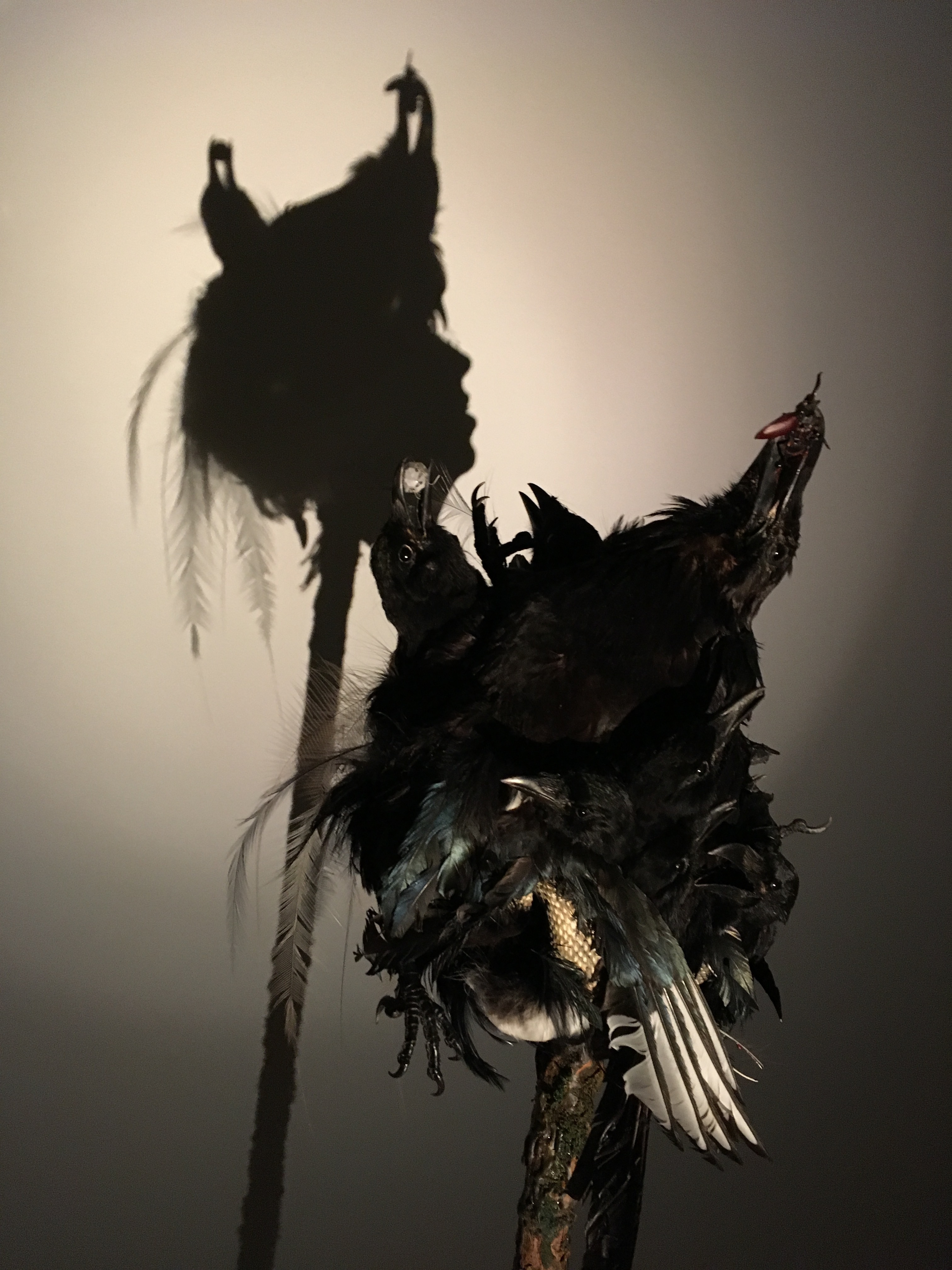
Image: Tim Noble and Sue Webster
I thought it would be easy to produce a piece for the Digest because I’d given a talk on the subject of nameless dread a few years ago and a 5000-word text [1] was waiting to be edited down and restyled. The paper I’d written was invited to address an academic psycho-social conference, to ensure that climate issues were included in their programme. Wilfred Bion’s concept of ‘nameless dread’, a state of mind that is unthinkable, is central to how he conceptualises trauma: unthinkable experiences cannot be brought to thought, so they stay in the body as trauma. My approach was to extend the concept of trauma beyond the clinical world with its intrapsychic focus, beyond the relational approach to intergenerational and transgenerational trauma, into the trauma of cultural ruptures and colonial violence, and from there to the existential trauma of the end of fossil fuel modernity and civilisational collapse. It looked to me as if everything was tinged with trauma and the unsymbolisability that accompanies it. Alongside this analysis, I considered the ways in which climate and ecological collapse differed from the events, the holocaust in particular, that characterise trauma theory.
I did have a warning sign about the difficulty of the subject matter: after I’d delivered my conference talk – on Zoom – there was a frozen silence, which I put it down largely to the fact that the physical part of this hybrid conference, somewhere in New Jersey, meant that I was cut off from the audience.
After avoiding the conference paper for ages, I took steps to process the subject matter further. Following the adage that ‘it takes two minds to think a person’s most difficult thoughts’ [2], I sought comments from Paul Hoggett. I revised the conference paper. Then I offered the topic for the CPA monthly Collapse Conversation and asked Paul to act as a discussant there. The group could help the process of digestion; the attempt to turn nameless dread into dreadful naming (as one helpful group member suggested). I got some useful comments from that session [3] and revised the paper again. What emerged was less gloomy and more nuanced: trauma is not necessarily a frozen state; it coexists with possibilities of digesting the undigestible.
Nameless dread
Wilfred Bion’s concept of ‘nameless dread’ is about unsymbolisability, of being unable to name, or more broadly symbolise, potentially traumatising experiences. Unprocessed painful experience sits on the body as trauma until and unless it can be brought into thought. This is where Bion’s theory of thinking opens out psycho-socially: external world conditions – not just other people but cultural objects – can create containing conditions for helping to bring experience to thought. Cultural ruptures – for example due to colonial violence or displacement – create the conditions for widespread trauma.
Reflection
Why could I not manage to turn my paper into a 1000-word Digest? As Digest editor, I wrote the brief that asks authors to include self-reflection in their writing; as author, time now to reflect some more on what was causing me trouble. If I was digging out the worst possible scenario by using the lens of trauma, how true is it; is it exaggerated?

Image: Wendy Hollway
What motivates my choices to engage in climate psychology, reading and writing about collapse and the ending of human civilisation, about mass extinction, about the breakdown of Gaian planetary balance, the widespread existence of trauma? How am I facing the pains, destruction and damage of this moment in history, my location in this world at the end of Modernity? I have noticed how I value some of the most hard-hitting accounts of our historical moment. I detect, underneath being horrified by the mounting signs of civilisational collapse, a grim feeling that this was deserved; that Modernity is getting its come-uppance with a figure like Trump precipitating the collapse of the current fossil-fuelled era. I detect a seam of detestation of Modernity, despite its conveniences and a recognition of my dependence on it. I notice how deep-seated and widespread is my feeling of its wrongness. I recognise how angry I am about the depredations that have accompanied my lifespan, which is exactly the span of what is called the ‘great acceleration’, that period in post-war Modernity in which rampant capitalism took off, with its psychological hooks of consumerism and individualisation.
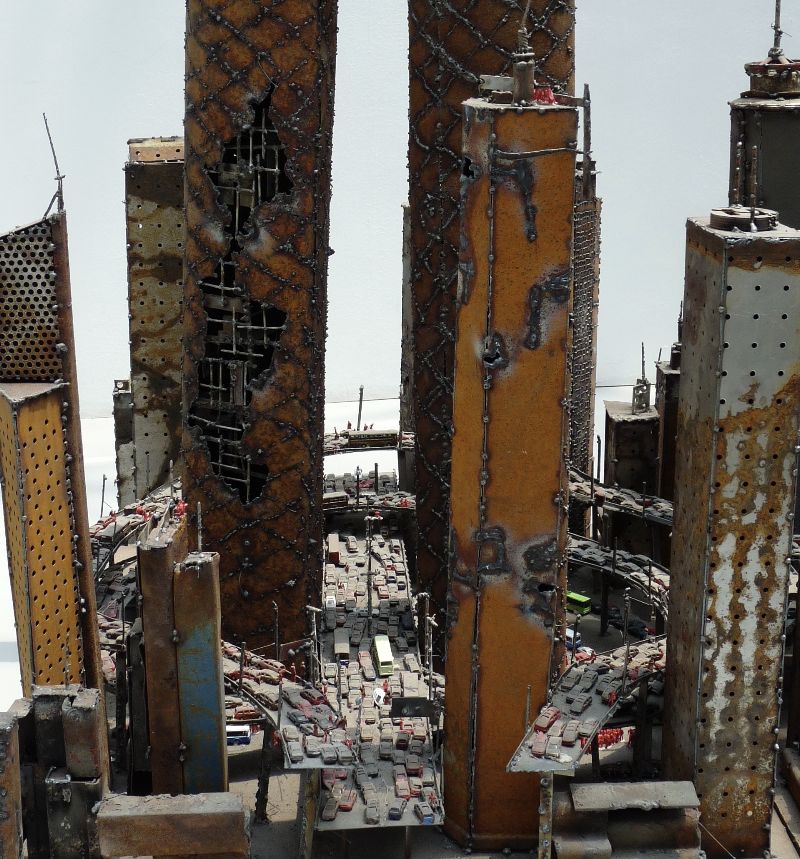
Image: City (2008) by Zhong Kangjun
Because of this, I suppose, I sought writing that captured the profundity of what is happening. For example, when I first read about the end of Modernity, in Bruno Latour’s Down to Earth [4], I was elated. I’d found a suitably complex, plausible explanation of the world’s current predicament. Moreover, I could trust it because it did not try and fob me off with notions of how climate change can be turned around in time. Latour refers to a ‘massive event that has intervened to put in danger the great modernisation project’. That project has become impossible ‘because there is no Earth capable of containing its ideal of progress, emancipation, and development’. He identifies December 12th 2015 – the day in Paris at the end of CoP21 when the climate agreement was reached – as the moment when all signatory countries … ‘realised with alarm that, if they all went ahead according to the terms of their respective modernisation plans, there would be no planet compatible with their hopes for development. They would need several planets; they have only one’. Paradoxically, I felt better, even though Latour’s analysis brings home the profound gravity – irreversibility - of the situation. I was thrilled that someone was exposing the awful hypocrisies of world leaders. An aspect of the nameless dread is brought to the light of explanation. Latour’s brilliant intellectual prowess, coloured by his indignation, provided me with a trustworthy analysis that acted as truthful container (a place of sufficient safety for thinking scary thoughts). It was reassuring despite and because of its clarity about how modernisation must collapse.
I continue to read all this distressing stuff about existential dread and collapse. I don’t fall apart. At what cost? To what extent do I succeed in thinking about the dreadfulness of collapse and the extent of trauma at the expense of feeling the gravity of it? To what extent am I intellectualising to defend against feeling it? The radical feature of Bion’s theory is that thinking is an emotional process. Intellectualisation is ‘not thinking’ (–K in Bion’s terminology) because it is stripped of emotion. How much feeling-thinking can any of us bear? For Bion, thinking is also a psycho-social and cultural process because disturbing experiences need a container (either external or internalised) to help bring them to thought. The Digest aims to be such a container. Hopefully, by this kind of reflection I have found a way of turning an academic conference paper into a Digest piece, in the process turning nameless dread into dreadful naming.
In parallel with this process, as Digest editor I have been wondering how the Digest can keep up with the enormity of the Earth’s calamity and its rapid deterioration. In a way, writing this month’s Digest is an exercise in what I am asking others to attempt when they write about their chosen topic: how can we hold in mind this enormity while finding thinkable themes that are not veiled in abstraction. The expectation that authors can reflect on the process while writing is part of the answer. As the editor, I am available for support. Are there further ways of helping us think difficult thoughts through the Digest in an equivalent way to climate cafes? If you are interested in authoring a Digest, whether daunted or not, please get in touch.
Notes
[1] The Nameless Dread of Climate and Ecological Collapse by Wendy Hollway, shared in the CPA Community Hub: https://network-7736199.mn.co/posts/99912816?utm_source=manual - If you are not a CPA member and wish to access, please email admin@climatepsychologyalliance.org
[2] Thomas Ogden (Bion-inspired American psychoanalyst).
[3] Thanks to Paul Hoggett, Linda Aspey, Gillian Broad and all those who joined the Collapse Conversation in February 2026.
[4] Latour, B. (2018) Down to Earth: Politics in the New Climatic Regime. Cambridge: Polity Press. Quotes from pages 16 and 5 respectively.
Author's Bio
Wendy Hollway
Wendy Hollway is editor of the Climate Crisis Digest. She co-authored the book Climate Psychology: A Matter of Life and Death with fellow CPA members Paul Hoggett, Chris Robertson and Sally Weintrobe.