The Law of Unintended Consequences: What the Palestine Action Proscription Means for Therapists
By Nicky Marshall
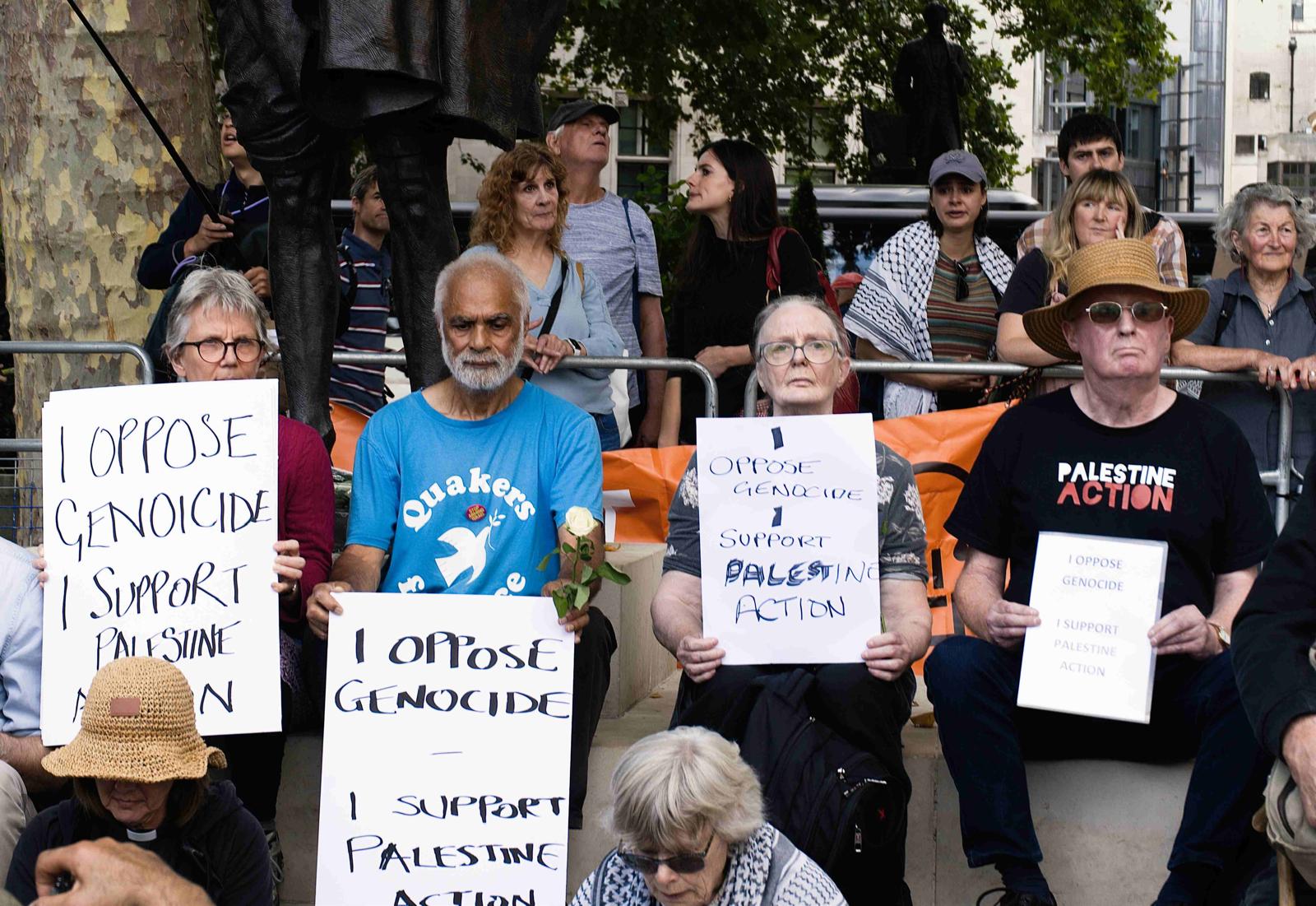
Image credit: Unknown
This piece began as a submission for my regular supervision column for a professional publication, but the complexity of the topic and the importance of incorporating responses from their legal team meant that it has evolved into this month’s feature for the CPA Digest.
Every so often, something becomes enacted in legislation that, on the face of it, has little, if anything, to do with the practice of therapy. For instance, the Data Protection Act 2018 widened the scope of the requirement for organisations not previously covered by the legislation to register with the Office of the Information Commissioner as data holders and to identify a named data controller. Although this was not directed at individual therapists in private practice, many of us ended up having to register. However, the need to register and pay the (relatively small) annual fee is not too big a deal for most of us, whereas the proscription of Palestine Action and the ongoing uncertainty as to how the various appeals processes will conclude has generated significant concern amongst some members of our profession whose practice it has potentially impacted.
What I hope to explore here is the way in which the proscription of Palestine Action has potential implications for therapists working with activists, and also those of us who supervise them. Under the Terrorism Act 2000 (Proscribed Organisations) (Amendment) Order 2025, Palestine Action (PA) was proscribed along with the Maniacs Murder Cult and Russian Imperial Movement. The Terrorism Act is one of the few pieces of legislation to impose mandatory requirements on therapists to breach client confidentiality, or themselves become liable for prosecution [1]. If a therapist becomes aware that a client intends to act in such a way that they would be liable to arrest and prosecution under the terrorism legislation, the therapist has a legal duty to report this. Additionally, if a therapist warns a client not to reveal information or they will have to breach confidentiality and report them, that warning is also a breach of the law under the Act.
As a therapist and supervisor with a deep interest in ecopsychology and what it means to practice in an era of ecological and environmental crises, I have several supervisees with similar interests who also work with environmental activists. Unsurprisingly, there is something of a cross-over between that client group and the activists who protested in support of Palestine Action, which brings me to the unexpected consequences: a supervisee flagged that she was working with an activist who was deeply disturbed by the proscription. At that point, the client had not specified whether they were planning to attend one of the upcoming protests, although they were known by the supervisee to have taken part in climate protest actions. However, the supervisee has the usual statement in her contract covering those times (risk of harm to self or others), which limit her ability to maintain confidentiality.
If my supervisee advised the client not to tell her about a definite plan, then she could be deemed to be breaking the law herself. If she doesn’t warn the client of the limits of confidentiality and is then told something which she doesn’t report, she could again be judged to be breaking the law. If she tells me that she has warned her client, or that her client has disclosed an intention and the supervisee has chosen not to report it, as her supervisor, I could be seen to have been made aware that an offence under the Terrorism Act had been committed by my supervisee. The therapist’s dilemma is then paralleled with my own – I can’t warn her not to tell me, nor decide not to report her, without myself potentially committing an offence under the legislation. It starts to feel like a cross between a Kafka novel and ‘Alice Through the Looking Glass’ with ever expanding circles of risk.

Image: János Szüdi
This also presents a scenario in which what is ethical and what is legal don’t always correlate: for example, whilst many therapists in private practice would consider it a deeply ethical act to report someone that they had clear grounds to believe was committing a sexual offence against children, they have no legal obligation to do so, although those working for statutory agencies - such as in education and the NHS - do. Conversely, the requirement to report a client intending to undertake peaceful protest, whilst legal, would I suspect, would feel very unethical to many practitioners.
As therapists, we have an ethical obligation to inform our registering bodies if we are charged with or convicted of an offence. The offence will be considered by such bodies in terms of whether the therapist has risked bringing the profession into disrepute. If that appears likely, then they may be subject to a professional conduct hearing, with the potential consequence of being struck off the register. Whilst this may seem unlikely, there are several world events that seemed improbable 10 years ago, such as the Brexit vote, the election of Trump as US president (not just once, but twice), and the removal of royal status from Andrew Mountbatten Windsor.
The offence of holding a placard whilst peacefully sitting on the ground, and the offence of not reporting the intention to protest in that way, don’t appear to be serious acts that endanger the reputation of the profession. However, I am not sure that I would like to bet my pension on not being sanctioned as a therapist charged with or convicted of an offence under the Terrorism Act, even if that were the ‘second hand’ one of warning or not reporting a client, or the ‘third hand’ one of a supervisor not reporting a supervisee for not reporting a client. Such an anxiety is heightened by the fact that other professionals have been suspended and risked being struck off their professional registers for protesting. For instance, Sarah Benn is a retired GP who was suspended by the General Medical Council and faced being struck off the register for her involvement in climate protests. She spent 32 days in prison after being found guilty of contempt of court for breaching an injunction to cease participating in Just Stop Oil protests. [2] If it is possible that a medical professional can lose their registration for an activist protest that is not designated as an act of terrorism, then those convicted under the Terrorism legislation must be at a similar, if not heightened, risk.

Image: Savannah Bolton
I contacted the British Association for Counselling and Psychotherapy (BACP) ethics hub to find out what their likely position would be in relation to the issues I have raised here, since they are the holders of one of the largest professional registers for the therapy professions. They stated: “All BACP Members must at all times act in accordance with the expected ethical principles, values and professional standards for BACP Members. The BACP Ethical Framework recognises that in exceptional circumstances, the need to safeguard clients or others from serious harm, may require a Member to override client wishes and confidentiality. This may be relevant where a matter arises which relates to the prevention of terrorism. [...] You have an ethical responsibility to confidentiality, but also may have legal or ethical obligations to disclose terrorist activity. Palestine Action is now a proscribed Terrorist Organisation so would come under the above duties and responsibilities. [...] ”
Whilst this may be fair, it doesn’t really give me a lot of comfort when considering my position in relation to working with activist clients and with supervisees. The supervisee whose question prompted this piece also spoke with a legal adviser who specialises in working with activists; the advice they received was to strengthen her privacy and confidentiality statement on her website to emphasise the limits to confidentiality with respect to proscribed organisations would not place her in legal jeopardy. This seems a good approach for anyone who works with clients for whom this could become an issue, although the chilling effect on our practices cannot be calculated. It seems that a ‘limits to confidentiality’ statement might reasonably state that this includes “any information disclosed in therapy that meets the reporting requirements of the Terrorism Act 2000, including that relating to support for Proscribed Organisations”.
At the time of writing, we are still awaiting the outcome of the appeal against the proscription by Huda Ammori to the Supreme Court. This appeal is another in a series that begins to feel like a game of ping-pong, but which leaves many of us with a deeply troubling uncertainty. Until the result of this appeal becomes known, we too remain in limbo as a profession, along with those thousands who have been arrested but not yet charged with an offence.
Author's Bio
Nicky Marshall is a UKCP registered psychotherapist with a particular interest in ecopsychology and ecospirituality. She is a trainer and retreat facilitator and writes regularly for the BACP Private Practice Journal. She is also a member of CPA's Therapeutic Support Directory. She lives in rural France.
If you are a therapist affected by the issues described by Nicky in this article, you may be interested in joining CPA as a member. CPA provides a space where difficult conversations around topics like these can be safely held amongst peers.
If you are an activist seeking support from a climate-aware therapist, you can access up to three free sessions (also available to anyone experiencing eco-distress). Please email support@climatepsychologyalliance.org for more details.