
'Lift the Ban’: Reflections on joining a Defend our Juries mass civil disobedience action’
Non-Violent Direct Action
The scene:
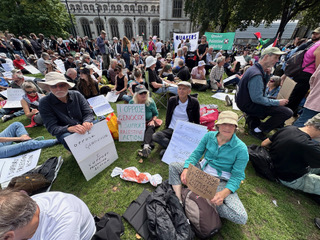
Photo: Michael Ryan
Several of us from CPA met together on Saturday, 6th September, to join the Defend Our Juries ‘Lift the Ban’ action opposing UK complicity in genocide and the proscription of Palestine Action. We all held signs ‘I OPPOSE GENOCIDE. I SUPPORT PALESTINE ACTION’ in defiance of the ban and under threat of arrest on terrorism charges.
Near us was a group of around 10 medics (dressed in their blue fatigues), a group from Quakers for Gaza and another group who had come up from Cornwall. On the far side of the square, a group held a banner ‘Holocaust survivor descendants against Gaza genocide’. It was unfortunate that a ‘pro-life’ anti-abortion campaign had been booked to use Parliament Square at the same time, as they occupied the road on the far side of the square. With their live music, the drums and chants of pro-Palestinian groups surrounding the sitting sign-holders and helicopters flying overhead, it wasn’t a particularly peaceful experience to begin with. However, as the afternoon went on and the ‘pro-life’ went home, it got better.
All the sitters were well-versed in Non-Violent Direct Action and were quiet and respectful towards the police. Unfortunately, some of the supporting crowd got into angrily shouting ‘shame on you’ at the police as they came to arrest sign holders, crowding around each arrest scene in what might be described as interference. Probably because of this, police reinforcements were brought in to surround and then carry or lead off each arrestee, and this meant that each arrest occupied around 8 police officers. This made it a slow process, and after 5 hours there were still relatively few arrests made. There was something surreal about sitting in the sun amidst an almost carnival atmosphere whilst people were picked off from the crowd.
Police/arrestee relations
Paul recounts:
Prior to being arrested I watched as those all around me were being carried off. On no occasion were they treated roughly, let alone brutally. We ‘sitters’ began to ask the crowd not to react aggressively to the police, as people around me said
‘they are just doing their job, just as we are doing ours’.

Photo: Michael Ryan
Wendy adds:
When I was in the long line on Millbank, waiting to be processed after arrest (we were there for three or four hours as the number of arrests built up), a nearby young woman said to her escort policeman ‘I despise you’. He replied ‘I’m sorry if I offended you’. He had just commented on the responsibilities of his position, in which he had to worry about some of the logistics. I said to her ‘he’s just doing his job’. She replied with a commonly used accusation, ‘that’s what the Nazis said’ (within his hearing). This woman soon sat down on the tarmac and refused to stand and keep up with her place in the line. She was lifted carefully each time the line advanced, by two officers. An hour or two later, she was provided with a trolley and could lie down quite comfortably and be pulled along, as on a sledge!
There are differences of opinion among arrestees about how to relate to police officers. Individual police escorts were alongside each of us for many hours, not letting us carry our own bags, nor phone, nor drink our own water (though water was provided on request). Once I’d declined to provide my name and address details on arrest (as advised by Defend Our Juries in order to tie up more police time), it seemed to me that there was a free space for conversation. Around me I heard interchanges where officers and arrestees were chatting as they might in a neutral situation. This possibility depended on arrestees not ‘othering’ police officers, as if they are not people with feelings too, despite the craziness of the situation they were obliged to deal with.
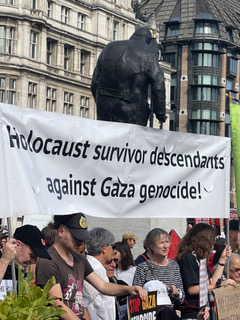
Photo: Michael Ryan
In this regard Paul writes:
In my experience, although the long queue was frustrating and (in my case) physically discomforting, it did wonders for police/protestor relations, with conversations breaking out everywhere. I found out about my officer’s two dogs, her boyfriend in Manchester, her university experience, her Polish mum, etc. Meanwhile, the ‘couple’ next to me turned out to be a former Home Office civil servant who had been involved in developing ‘key performance indicators’ for the police (he was now arrested) together with an officer from Avon and Somerset constabulary who shared his Twix Bar with me and had been taught by my son when he took his degree. I think conversations like these were going on everywhere.
Media treatment
What we were less prepared for was the onslaught of accusations and counteraccusations which followed in the reporting. Many of the videos posted on Instagram captured vexatious exchanges between police and demonstrators, prioritising the reports of ‘violent clashes’. Not noted were the respectful and courteous exchanges between police and demonstrators, in the spirit of nonviolence, encouraging dialogue and exchange of views wherever possible.
The war of absolutes ends dialogue – it is the endpoint reached when we no longer tolerate different ways of seeing things. In the days after the Parliament Square protest there was much online discussion among Defend Our Juries supporters, and a general feeling that, next time, DOJ should be more proactive in terms of their relation to the crowds that turn up to support them. The organisers need to insist that if you come to support us you are invited to participate in a non-violent, non-confrontational manner, to respect and emulate the ethos of NVDA. (October’s action apparently succeeded better in abiding by this ethos.)
The total number of arrestees in the September action was in the region of 900. A large proportion of these were older people, like us. Whilst the media seem to scoff at the idea that the State finds ‘elderly pensioners’ a threat, it seems to us that, as we are relieved of our professional duties and responsibilities, we are freed up to remind the government of theirs. Whilst Starmer’s government is attempting to shut down debate and curb our rights to free speech and free assembly, we are drawing attention to a question that is not being answered: Why, despite its belated recognition of Palestinian statehood, is this government remaining complicit in genocide?
Tree Staunton, with Paul Hoggett and Wendy Hollway.
Author's Bio
Tree Staunton is a UKCP Honorary Fellow, and an Emeritus member of Bath Centre for Psychotherapy and Counselling (BCPC), where she was Director from 2011-2023. She has been a Registered Body Psychotherapist, Supervisor and Trainer for over 30 years, and is a long-standing member of Climate Psychology Alliance, UK.