Co-founder of Climate Psychology Alliance, Adrian Tait, has recently contributed a chapter to a new book edited by Jem Bendell and Rupert Read called Deep Adaptation: Navigating the Realities of Climate Chaos, in which he explores the relevance climate psychology has to Deep Adaptation. The following is a piece that Adrian has written based on that chapter:
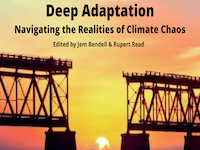
It was an honour to be invited to contribute a chapter for Jem Bendell and Rupert Read's forthcoming book Deep Adaptation: Navigating the Realities of Climate Chaos. It provided a welcome opportunity to explore the connections between Climate Psychology and the Deep Adaptation project.
In the twelve years since the Climate Psychology Alliance (CPA) first started to form, much has changed and much hasn't. Some of the change has been interactive – CPA has been on a collective journey through the psycho-social landscape of the climate- and ecological crisis, spotting and attaching names to its features: denial, grief, radical hope, cultural complexes, therapy for our times and so on. My chapter goes into all these. The landscape, both physical and cultural, has itself been changing, sometimes subtly, sometimes dramatically.
One defining purpose of CPA is the need for alliances – not just operational links and collaborations (important as these are) but deep-seated respect, mutual support, the love and sense of inter-dependence which arises from a common cause that transcends all of us in its magnitude. The co-operation between CPA and the Deep Adaptation Forum is a prime example of mutually supportive alliance. CPA has been able to share some perspectives from depth psychology as well as offering therapeutic backup. Deep Adaptation for its part helped to galvanise CPA's therapeutic aspirations and has done much to advance the core value embodied in our strapline: Facing Difficult Truths. Jem Bendell's 2018 Deep Adaptation paper gave focus to the warnings from climate science, challenged the taboo around the spectre of collapse and contributed to a shift in public awareness. That shift has, in turn, seen a widening and intensification of climate activism across groups and generations, although this has been constrained by the Covid-19 episode. Extinction Rebellion has played a big part in that.
Not surprisingly, there remains much resistance to discussing collapse, even amongst people who are otherwise allies. But its currency as a topic has, I suggest, done some much needed peeling-away of widespread disavowal. To modify the famous words of Yeb Sano after Super Typhoon Haiyan hit the Philippines in 2013 we, collectively, are all too adept at responding to climate chaos and ecosystem collapse with a proverbial, "Yes, yes, but not me, not now, not here."
At the heart of the common cause in climate and ecological awareness and action is the need to care better – for each other and for the greater-than-human world. Deep Adaptation is steeped in the psychotherapeutic and spiritual insight that we should not project our own failings and weakness onto others. But this emphasis on self-awareness must not blind us to the fact that a key reason why our alliances are important is that we face determined and resourceful opponents with strikingly different values from our own. We have to steer clear of "holier than thou" positions and at the same time recognise the thoroughly unholy alliance between petro-states like Russia and Saudi Arabia, the Murdoch Press and Trumpism. There is credible evidence for instance that, in a shift from hard denial to deflection and division, cyber-warfare is playing an increasing role in undermining the coherence of the climate movement. There is a public tide in favour of climate awareness, but we can't afford a repeat of the complacency following the award of a Nobel Peace Prize to Al Gore and the IPCC in 2007.
We have a tricky line to walk. As Deep Adaptation insists, the time is long gone when we could accept the narrative that all will be well if we just see the error of our ways and take sensible steps to correct them. But the message that we are really not above Nature, that the consumerist high emissions party must end (and the longer it lasts the messier the ending will be) remains a very hard sell. Entitlement and heavy footprint aspirations are so deeply embedded in our culture. Maybe it's out of our hands and we are over the long slow cliff already. Maybe zoonotic viruses or a pollution-induced collapse in human fertility will finally halt the rampage of the more greedy members of Homo Sapiens. Such blunt instruments would hardly correct the gross social injustices which are ensuing from climate and ecological decay, but they might at least herald in a re-stabilization of Earth Systems over the coming millennia. And maybe we can draw on Deep Adaptation to find a humbler, more stable way of sharing what's left of our planetary home.
Rupert Read's and Jem Bendell's book should help to give some fresh encouragement to those of us striving to find a sane and real perspective on where we are at this point in Earth's history and our own.
Adrian Tait.
28th February 2021.
The book is available to buy from the publisher.