

Research and resources, shaped by those doing the work

Dark woodland in evening light
Unfurling fern frond

We're a community of researchers, practitioners, and thinkers committed to disseminating climate psychology widely, not just within our own professional circles. Through our flagship journal Explorations in Climate Psychology, our podcasts and talks, our library, and the contributions of members from across the world, we work to build a shared understanding of how psychology can meet this moment.

Explorations in Climate Psychology - the CPA journal

Navigating the inner and external work (relational and socio-political) that this moment calls on us to do, Explorations in Climate Psychology is CPA's flagship journal, published annually. We aim to be inclusive of the different ways people experience and engage with the climate and ecological crisis and welcome a wide range of forms: peer-reviewed research, analytical articles, reviews, interviews, reflections, testimonies, poetry, art, and lightly edited conversations.

Edited by CPA's Explorations Group, the journal explores current and emerging themes in the field, from climate grief and trauma to colonialism, decolonisation, the limits of Western rationality, and what it means to "stay with the trouble." The current editors of Explorations are noted in the latest issue.
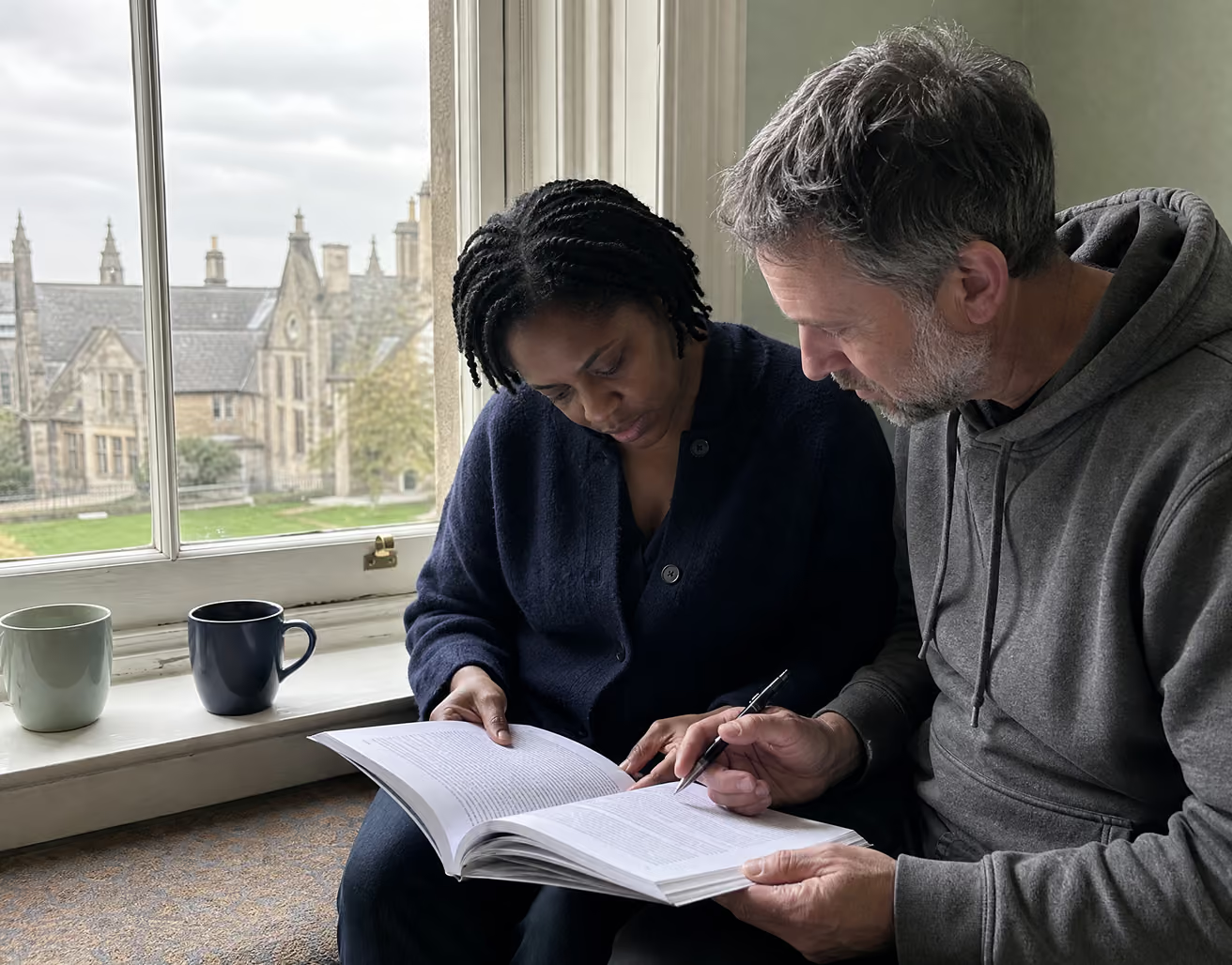

Two people reading an issue of the Explorations in Climate Psychology journal together
Three people researching together at a table with laptops and notes

We welcome contributions from inside and outside the CPA Community.

Find the latest call out here and guidelines for contributions here. The journal is open access and contributions can be used and quoted as long as they are referenced.

The Explorations group also offers online events with authors and other leading voices, which explore journal topics further.

See what's coming up

If you are interested in joining the editorial team (we particularly welcome young people and those of the Global Majority),  or wish to get in touch for another reason you can email them here.

A journal of climate psychology

Published regularly, featuring essays, research, and creative work from contributors across the UK and internationally. Each issue explores innovative forms of thinking and writing, navigating the relational and socio-political dimensions of the climate and ecological crisis.

Latest issue: Heavy weather: Exploring reactionary states of mind

Issue 8 is out now. In it you'll find explorations of the post-truth world, group narcissism, the unconscious, AI and power, and how these contribute to the reactionary state of mind.

Explorations: A journal of Climate Psychology

Published regularly, featuring essays, research, and creative work from contributors across the UK and internationally. Each issue explores innovative forms of thinking and writing, navigating the relational and socio-political dimensions of the climate and ecological crisis.

We also publish pieces from our journal via our Substack account. You can connect with us there, just follow @climatepsychologyexplorations on Substack.

New to Climate Psychology? Start here

Climate psychology is a young field with deep roots. If you're new to it, the resources below are good places to begin: foundational guides, podcasts and videos, defining texts, and the essential reading that practitioners and researchers return to again and again.

Hands resting on a book beside a mug and reading glasses
Three people in discussion around a coffee table

The Handbook of Climate Psychology

CPA's foundational guide to the field, freely available to download. The handbook introduces the key concepts, frameworks, and questions that shape climate psychology, and is used widely as an entry point for practitioners, researchers, and the curious.

Free Open University course

Introducing Climate Psychology: facing the climate crisis

The course explores ideas from social theory, psychoanalysis, ecopsychology, eco-feminism and post-humanism to gain a deeper understanding of the climate and ecological crisis, its impact on our wellbeing and how to build psychological resilience. The course is endorsed and supported by the CPA.

Climate Crisis Conversations

Our podcasts offers an accessible, conversational entry point into climate psychology, featuring CPA practitioners, researchers, and friends in dialogue about the climate and biodiversity crisis and the full range of emotional responses to it.

Motherhood and the Climate Crisis

Dr Renée Lertzman on being an earthling, the climate crisis and falling in love

Did we Care When Birds and Animals Died during the Sixth Extinction?

What our members are sharing

Climate psychology is built collaboratively, by members for members and beyond. The work below reflects what people across our community are thinking about, researching, writing, and making right now. These are member contributions, not CPA publications, voices from across the alliance.

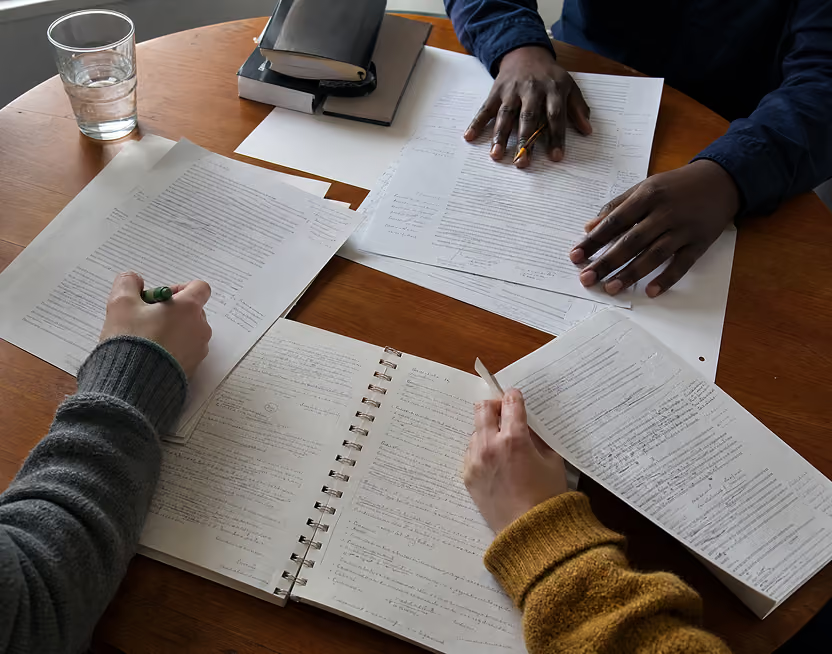
CPA members sharing handwritten notes around a table
Thinking Space
Climate and ecological emotions
Climate justice & decolonising

Hosting and facilitating a Climate café listening circle (CCLC) training

Do you want to help build resilience in your community? Climate Cafe LIstening Circle (CCLC) Training builds the confidence, skills, and peer community to facilitate your own circles. Delivered as a structured programme over three sessions in closed cohorts, with ongoing supervision and support afterwards.

Wet garden path through lush greenery

The Climate Crisis Digest is our monthly publication, usually a short piece written by members.

The name Digest reflects the psychoanalyst Wilfred Bion's insight that experience needs to be digested in order to be thinkable, especially when it is hard to bear (hence CPA's approach to difficult truths). The Digest style is not academic or polemical, more journalistic and exploratory in tone. That requires reflection by the author, to invite reflection in readers. Reflection here means inquiring into our emotional experience so as to more fully engage with the meaning of what is written.

The Digest is edited by Thulsi Prabakaran.

Subscribe to our newsletter.

All news posts

Our library is a collection of open-access research and resources, written or recommended by CPA members.

Displaying
1
of
1
articles
Thank you! Your submission has been received!
Oops! Something went wrong while submitting the form.
Theory and frameworks
Climate and ecological emotions
Activism & collective action

Ecology, Psychoanalysis and Global Warming: Present and Future Traumas (Editorial)

Editorial introducing a special issue of Journal of Social Work Practice arising from a December 2018 Tavistock and Portman/CPA conference, exploring what psychoanalysis, philosophy, science and activism can contribute to understanding and communicating about ecological disaster and the eco-anxiety it provokes.

2020
Research papers
Anna Harvey
Ecology, Psychoanalysis and Global Warming: Present and Future Traumas (Editorial)
Harvey
2020
Theory and frameworks
Activism & collective action

Psychosocial factors influencing pro-environmental decision-making in organisations

Whilst awareness of the importance and urgency of acting to mitigate anthropogenicenvironmental change is generally high, adaptive responses have matched neitherthe scale nor the complex nature of the challenge. Inertia at individual andorganisational levels is a troubling conundrum.In this paper, we analyse the psychosocial factors at work for individuals attemptingto influence their organisations’ pro-environmental actions. Our study focuses on sixindividuals with pro-environmental values who have formal roles in their organisationwith regard to environmental policy, strategy and practice.

2015
Research papers
Nadine Andrews
Kathryn Fahy
Stuart Walker
Psychosocial factors influencing pro-environmental decision-making in organisations
Andrews
2015
Theory and frameworks
Climate and ecological emotions
Hope & resilience

Facing Up to Ecological Crisis: A Psychosocial Perspective from Climate Psychology

This book from the Green House collective offers climate honesty. The time for focusing primarily on mitigation is over. We now need to adapt to the dark reality of climate breakdown. But this means a deep reframing of our entire way of life. The book explores how transformative adaptation might enable us to confront escalating climate chaos while not giving up hope.Facing up to Climate Reality is a book for those brave enough to abandon the illusion of continuing normality, and embark on a harder, truer journey.

2019
Books & chapters
Nadine Andrews
Facing Up to Ecological Crisis: A Psychosocial Perspective from Climate Psychology
Andrews
2019
Theory and frameworks
Climate and ecological emotions
Hope & resilience

Psychosocial factors influencing the experience of sustainability professionals

Drawing on Interpretative Phenomenological Analysis, this study explores the lived experience of six sustainability professionals and leaders in the UK and Canada. It identifies key psychosocial factors shaping their experience - particularly psychological threat-coping strategies, psychological needs, motivation and vitality - and models the complex interactions and trade-offs between them, including tensions between competency, relatedness and autonomy needs and coping strategies such as suppression of negative emotion and a threatened 'deep green' identity.

2017
Research papers
Nadine Andrews
Psychosocial factors influencing the experience of sustainability professionals
Andrews
2017
Nature connection
Theory and frameworks

How Cognitive Frames about Nature May Affect Felt Sense of Nature Connectedness

Nature connectedness tends to be understood as a relatively stable trait, studied using survey-based methods. But this approach is not well suited to investigating the nuances and unconscious processes of subjective experience. This paper addresses these limitations by using an alternative approach. I analyze the lived experience of nature connectedness using a post-positivist transdisciplinary methodology integrating IPA with frames and metaphor analysis from an ecolinguistics perspective.

2018
Research papers
Nadine Andrews
How Cognitive Frames about Nature May Affect Felt Sense of Nature Connectedness
Andrews
2018
Nature connection
Climate and ecological emotions

The Long Return: an essay on belonging

This is an essay about belonging. It is also about connection, identity and shame. What is it about the sight and sound of Swifts, swooping and circling, shrieking and calling, that gets to me so much? After almost 30 years living elsewhere, this was one of the things I was most excited about, to enjoy the Swifts once again, over and over, in the long evening light of an Edinburgh summer. It had tugged and tugged on my soul for years, so when it didn’t happen I was devastated, distraught.

2020
Articles & reflections
Nadine Andrews
The Long Return: an essay on belonging
Andrews
2020
Climate and ecological emotions
Denial & avoidance

The Emotional Experience of Members of Scotland's Citizens' Assembly on Climate Change

In facing up to the reality of the climate crisis and the risks it poses, people encounter powerful emotions that can be difficult to bear. Consequently, various defences and coping strategies may be used to suppress or avoid feeling these emotions. The way in which emotions are regulated has important implications for wellbeing and decision-making. In recent years there has been growing interest in using citizens' assemblies to inform government climate policy. Assembly members learn about and discuss the subject, and produce recommendations for action. Given this element of learning about climate change, it is likely that difficult emotions will come up for assembly members. This paper investigates the emotional experience of members of Scotland's Climate Assembly to explore which, if any, emotions are experienced and how they are regulated.

2022
Research papers
Nadine Andrews
The Emotional Experience of Members of Scotland's Citizens' Assembly on Climate Change
Andrews
2022
Climate and ecological emotions
Therapeutic perspectives
Denial & avoidance

The Mental Health and Emotional Impacts of Climate Breakdown: Insights from Climate Psychology

This chapter discusses the need for robust psychologies in the context of the devastating global health impacts of climate breakdown, with particular focus on the psychological impacts. It describes temperature effects (suicide and other deaths, especially in the vulnerable), the traumatic impacts of repeated and one-off climate change related weather events, and the many varieties of eco-distress. It reflects on the profound and complex psychologies associated with inaction, avoidance and a clinging to ‘business as usual’ in high- and middle-income countries.

2024
Books & chapters
Rebecca Nestor
The Mental Health and Emotional Impacts of Climate Breakdown: Insights from Climate Psychology
Anderson
2024
Therapeutic perspectives
Climate and ecological emotions
Therapeutic Support

Being a Therapist in a Time of Climate Breakdown (full collection)

This book introduces readers to the known psychological aspects of climate change as a pressing global concern and explores how they are relevant to current and future clinical practice.Arguing that it is vital for ecological concerns to enter the therapy room, this book calls for change from regulatory bodies, training institutes and individual practitioners. The book includes original thinking and research by practitioners from a range of perspectives, including psychodynamic, eco-systemic and integrative. It considers how our different modalities and ways of working need to be adapted to be applicable to the ecological crises.

2024
Books & chapters
Judith Anderson
Being a Therapist in a Time of Climate Breakdown (full collection)
Anderson
2024

Join our community of thinkers, researchers, and reflective practitioners

CPA is more than a publisher or a library. We're a working community of people thinking together about climate psychology. Our members participate in regular Thinking Spaces, contribute to research groups, edit the Explorations in Climate Psychology Journal, maintain the library, and bring their own work into shared conversation. Research at CPA is collaborative, generative, and grounded in practice.

Why join:

  • Monthly Thinking Space

  • Research Group

  • Opportunities to Publish

  • Intergenerational buddying

  • Student and Young Members Group

  • Opportunities to Publish

House with lit windows under a sunset sky