

Research and resources, shaped by those doing the work

Dark woodland in evening light
Unfurling fern frond

We're a community of researchers, practitioners, and thinkers committed to disseminating climate psychology widely, not just within our own professional circles. Through our flagship journal Explorations in Climate Psychology, our podcasts and talks, our library, and the contributions of members from across the world, we work to build a shared understanding of how psychology can meet this moment.

Explorations in Climate Psychology - the CPA journal

Navigating the inner and external work (relational and socio-political) that this moment calls on us to do, Explorations in Climate Psychology is CPA's flagship journal, published annually. We aim to be inclusive of the different ways people experience and engage with the climate and ecological crisis and welcome a wide range of forms: peer-reviewed research, analytical articles, reviews, interviews, reflections, testimonies, poetry, art, and lightly edited conversations.

Edited by CPA's Explorations Group, the journal explores current and emerging themes in the field, from climate grief and trauma to colonialism, decolonisation, the limits of Western rationality, and what it means to "stay with the trouble." The current editors of Explorations are noted in the latest issue.
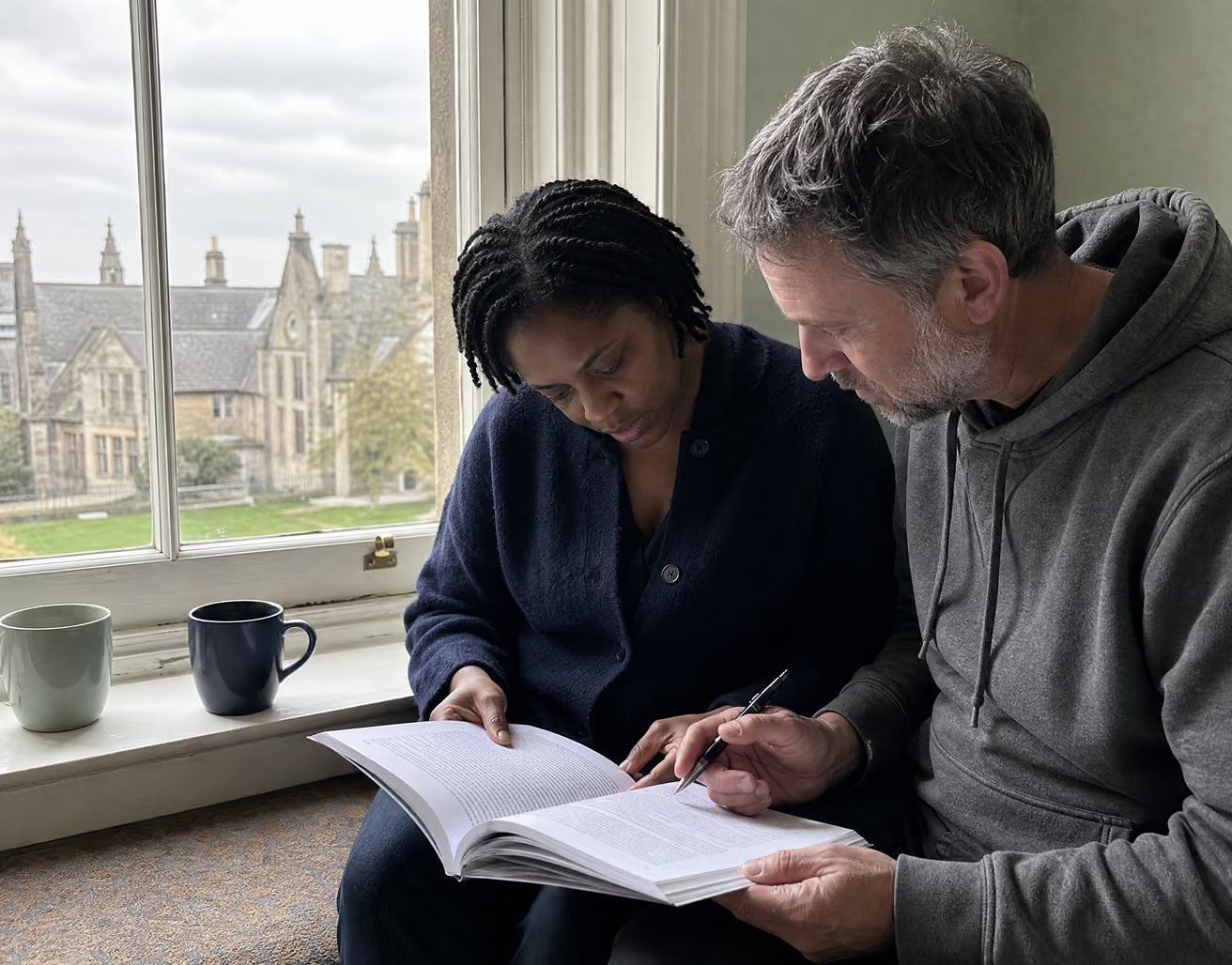

Two people reading an issue of the Explorations in Climate Psychology journal together
Three people researching together at a table with laptops and notes

We welcome contributions from inside and outside the CPA Community.

Find the latest call out here and guidelines for contributions here. The journal is open access and contributions can be used and quoted as long as they are referenced.

The Explorations group also offers online events with authors and other leading voices, which explore journal topics further.

See what's coming up

If you are interested in joining the editorial team (we particularly welcome young people and those of the Global Majority),  or wish to get in touch for another reason you can email them here.

A journal of climate psychology

Published regularly, featuring essays, research, and creative work from contributors across the UK and internationally. Each issue explores innovative forms of thinking and writing, navigating the relational and socio-political dimensions of the climate and ecological crisis.

Latest issue: Heavy weather: Exploring reactionary states of mind

Issue 8 is out now. In it you'll find explorations of the post-truth world, group narcissism, the unconscious, AI and power, and how these contribute to the reactionary state of mind.

Explorations: A journal of Climate Psychology

Published regularly, featuring essays, research, and creative work from contributors across the UK and internationally. Each issue explores innovative forms of thinking and writing, navigating the relational and socio-political dimensions of the climate and ecological crisis.

We also publish pieces from our journal via our Substack account. You can connect with us there, just follow @climatepsychologyexplorations on Substack.

New to Climate Psychology? Start here

Climate psychology is a young field with deep roots. If you're new to it, the resources below are good places to begin: foundational guides, podcasts and videos, defining texts, and the essential reading that practitioners and researchers return to again and again.

Hands resting on a book beside a mug and reading glasses
Three people in discussion around a coffee table

The Handbook of Climate Psychology

CPA's foundational guide to the field, freely available to download. The handbook introduces the key concepts, frameworks, and questions that shape climate psychology, and is used widely as an entry point for practitioners, researchers, and the curious.

Free Open University course

Introducing Climate Psychology: facing the climate crisis

The course explores ideas from social theory, psychoanalysis, ecopsychology, eco-feminism and post-humanism to gain a deeper understanding of the climate and ecological crisis, its impact on our wellbeing and how to build psychological resilience. The course is endorsed and supported by the CPA.

Climate Crisis Conversations

Our podcasts offers an accessible, conversational entry point into climate psychology, featuring CPA practitioners, researchers, and friends in dialogue about the climate and biodiversity crisis and the full range of emotional responses to it.

Deep questioning - navigating youth in a time of climate change

The power of art in helping us to 'see' climate change

Talking with children about climate change

What our members are sharing

Climate psychology is built collaboratively, by members for members and beyond. The work below reflects what people across our community are thinking about, researching, writing, and making right now. These are member contributions, not CPA publications, voices from across the alliance.

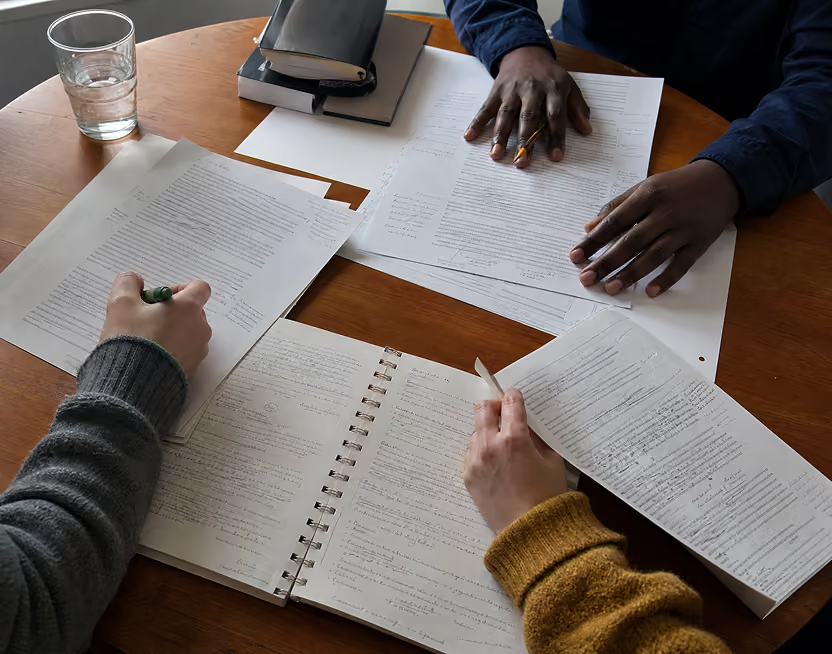
CPA members sharing handwritten notes around a table
Thinking Space
Climate and ecological emotions
Climate justice & decolonising

Hosting and facilitating a Climate café listening circle (CCLC) training

Do you want to help build resilience in your community? Climate Cafe LIstening Circle (CCLC) Training builds the confidence, skills, and peer community to facilitate your own circles. Delivered as a structured programme over three sessions in closed cohorts, with ongoing supervision and support afterwards.

Wet garden path through lush greenery

The Climate Crisis Digest is our monthly publication, usually a short piece written by members.

The name Digest reflects the psychoanalyst Wilfred Bion's insight that experience needs to be digested in order to be thinkable, especially when it is hard to bear (hence CPA's approach to difficult truths). The Digest style is not academic or polemical, more journalistic and exploratory in tone. That requires reflection by the author, to invite reflection in readers. Reflection here means inquiring into our emotional experience so as to more fully engage with the meaning of what is written.

The Digest is edited by Thulsi Prabakaran.

Subscribe to our newsletter.

All news posts

Our library is a collection of open-access research and resources, written or recommended by CPA members.

Displaying
1
of
1
articles
Thank you! Your submission has been received!
Oops! Something went wrong while submitting the form.
Therapeutic Support
Nature connection
Climate and ecological emotions
Therapeutic perspectives
Denial & avoidance

Is there a therapy for climate change anxiety? Therapy Today

Is there a therapy for climate-change anxiety?Steffi Bednarek calls for a collective response to a global ecological disaster

2019b
Articles & reflections
Steffi Bednarek
Is there a therapy for climate change anxiety? Therapy Today
Bednarek
2019
Youth & intergenerational
Climate and ecological emotions
Parenting

What Children Want Us to Know About Climate Change

Climate change can feel overwhelming. As we head up to Earth Day, some young people tell us how climate change makes them feel - and explore the best way to talk about it. Brief BBC animation featuring children's own perspectives on climate change, stemming from CPA member Caroline Hickman's research, offering guidance for having conversations with children.

Podcasts & talks
What Children Want Us to Know About Climate Change
BBC
Nature connection
Creative practice

Voice 11: Wings of Hope

A wildlife photographer describes discovering barn owls in a field behind his house, and the patience involved in capturing a single photograph over 20 nights of watching.

2024
Books & chapters
Hope Baxter
Voice 11: Wings of Hope
Baxter
2024
Therapeutic perspectives
Climate and ecological emotions

'Climate Mania'

This chapter offers a single clinical case study of what is described as 'climate mania', drawing on Lacanian theory to detail how climate change was central to the client's manic-depressive experience. It discusses how biomedical approaches to manic responses to climate threats can foreclose a person's sense of subjectivity in relation to the crisis, and indicates the need for further research into the intersections between climate change and extreme states such as mania and psychosis.

2024
Books & chapters
Garret Christopher Barnwell
Climate Mania'
Barnwell
2024
Climate justice & decolonising
Theory and frameworks
Nature connection

'Nothing green can grow without being on the land'

Extractive industries have a deleterious impact on social ecologies. Mining is one of South Africa's main industries, and communities' resistance takes place in these extractive zones. This qualitative case study aims to explore and describe mine-affected community members' psychological reactions and community responses to land and environmental injustices in the mining community of Rustenburg, South Africa. D

2020
Research papers
Garret Christopher Barnwell
Nothing green can grow without being on the land'
Barnwell
2020
Creative practice
Climate and ecological emotions

Voice 2: It's Hot as Fuck and I Need to Rest My Eyes

A short reflection on a painting made during a heatwave: 'Climate anxiety was making me feel like I was being swallowed by tar. This is the only way I know how to climb out.'

2024
Books & chapters
Fehinti Balogun
Voice 2: It's Hot as Fuck and I Need to Rest My Eyes
Balogun
2024
Climate and ecological emotions
Climate justice & decolonising
Theory and frameworks

A Critical Reading of Solastalgia Through Indigenous and Care Ethics Lenses

Solastalgia is the emotional response elicited by ecological degradation, originating from the concepts of solace, desolation, and pain. Climate change has profound societal and health impacts especially for marginalised communities who face food shortages, poverty and forced displacement. Indigenous peoples have deep relational ancestral connections with the land that are beyond connection to place, and experience unique intensified forms of distress resulting from environmental degradation. For Indigenous peoples, connections with land are disrupted through extractive politics such as colonisation and now climate emergency, legacies that leave deleterious effects on wellbeing. In collective Indigenous cultures, distress is embedded within wider contexts of community, history, and the earth itself. This paper critically reviews solastalgia from Māori and care ethics perspectives to demonstrate the power of adding relational, contextual, and embodied elements to the concept. This paper argues for the incorporation of Indigenous knowledge in the conceptualisation of climate-related distress. Māori notions of voice and place inform research approaches that are in solidarity with Indigenous voice to examine the impacts of climate degradation.

2025
Research papers
Baker, E.
Jones, D. K.
Brannelly, T.
A Critical Reading of Solastalgia Through Indigenous and Care Ethics Lenses
Baker
2025
Denial & avoidance
Activism & collective action

Exploring the associations of generalized trust, climate change conspiracy beliefs and freecycling: Empirical evidence from 34 cultures

This study examines the relationships between generalized trust, climate change conspiracy beliefs and freecycling - a community-based free-item sharing pro-environmental behaviour - along with the role of societal factors. Drawing on an online survey of 16,773 participants across 34 countries, the study finds that generalized trust and, unexpectedly, climate change conspiracy beliefs are both positively associated with freecycling participation.

2026
Research papers
Algae K. Y Au
Jacky C. K Ng
Sylvia Xiaohua Chen
Exploring the associations of generalized trust, climate change conspiracy beliefs and freecycling: Empirical evidence from 34 cultures
Au
2026
Therapeutic perspectives
Denial & avoidance

The big issue: Breaking out of the climate bubble

Linda Aspey explores why the therapyprofessions are still so silent on climate change

2021
Articles & reflections
Linda Aspey
The big issue: Breaking out of the climate bubble
Aspey
2021

Join our community of thinkers, researchers, and reflective practitioners

CPA is more than a publisher or a library. We're a working community of people thinking together about climate psychology. Our members participate in regular Thinking Spaces, contribute to research groups, edit the Explorations in Climate Psychology Journal, maintain the library, and bring their own work into shared conversation. Research at CPA is collaborative, generative, and grounded in practice.

Why join:

  • Monthly Thinking Space

  • Research Group

  • Opportunities to Publish

  • Intergenerational buddying

  • Student and Young Members Group

  • Opportunities to Publish

House with lit windows under a sunset sky