

Research and resources, shaped by those doing the work

Dark woodland in evening light
Unfurling fern frond

We're a community of researchers, practitioners, and thinkers committed to disseminating climate psychology widely, not just within our own professional circles. Through our flagship journal Explorations in Climate Psychology, our podcasts and talks, our library, and the contributions of members from across the world, we work to build a shared understanding of how psychology can meet this moment.

Explorations in Climate Psychology - the CPA journal

Navigating the inner and external work (relational and socio-political) that this moment calls on us to do, Explorations in Climate Psychology is CPA's flagship journal, published annually. We aim to be inclusive of the different ways people experience and engage with the climate and ecological crisis and welcome a wide range of forms: peer-reviewed research, analytical articles, reviews, interviews, reflections, testimonies, poetry, art, and lightly edited conversations.

Edited by CPA's Explorations Group, the journal explores current and emerging themes in the field, from climate grief and trauma to colonialism, decolonisation, the limits of Western rationality, and what it means to "stay with the trouble." The current editors of Explorations are noted in the latest issue.
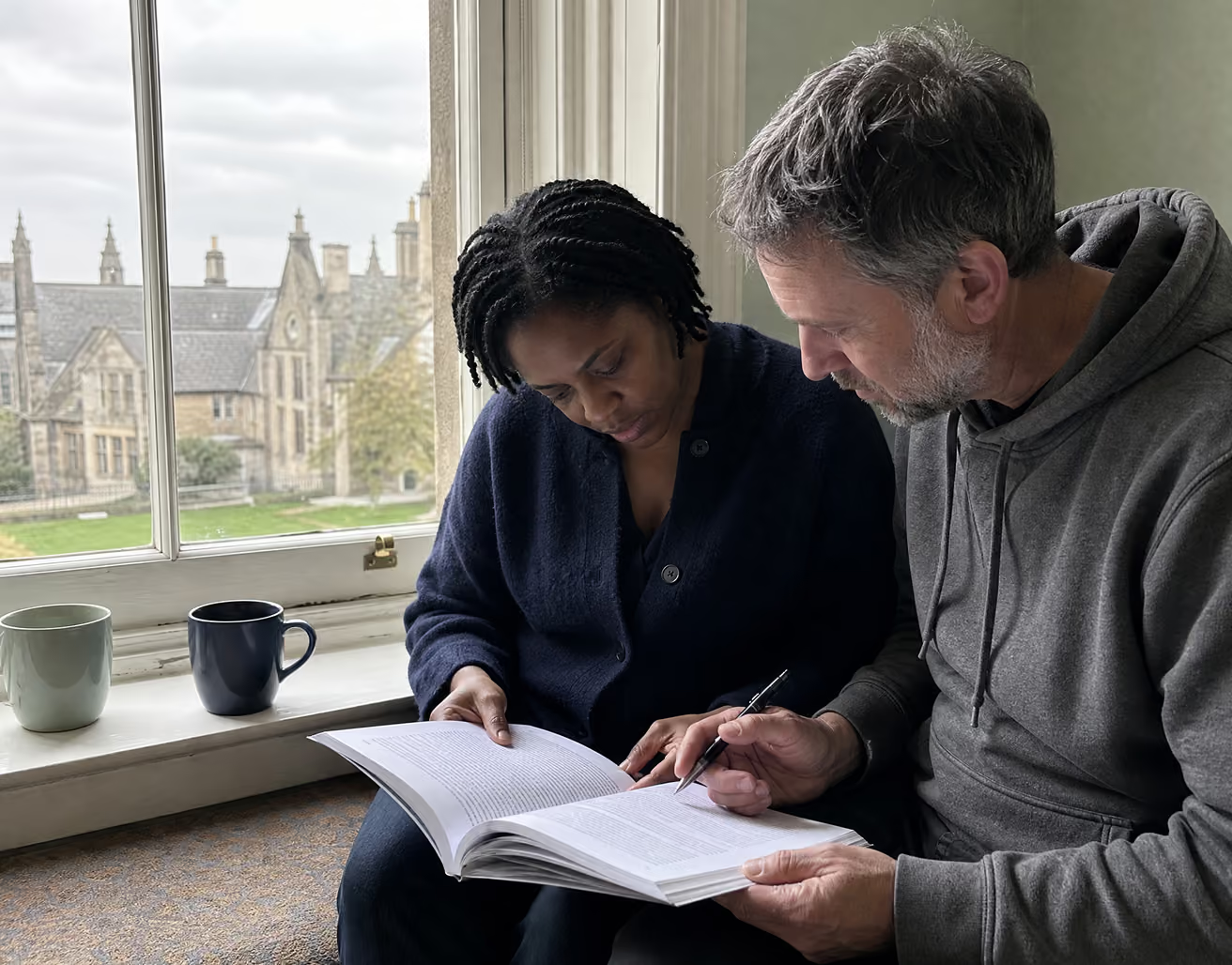

Two people reading an issue of the Explorations in Climate Psychology journal together
Three people researching together at a table with laptops and notes

We welcome contributions from inside and outside the CPA Community.

Find the latest call out here and guidelines for contributions here. The journal is open access and contributions can be used and quoted as long as they are referenced.

The Explorations group also offers online events with authors and other leading voices, which explore journal topics further.

See what's coming up

If you are interested in joining the editorial team (we particularly welcome young people and those of the Global Majority),  or wish to get in touch for another reason you can email them here.

A journal of climate psychology

Published regularly, featuring essays, research, and creative work from contributors across the UK and internationally. Each issue explores innovative forms of thinking and writing, navigating the relational and socio-political dimensions of the climate and ecological crisis.

Latest issue: Heavy weather: Exploring reactionary states of mind

Issue 8 is out now. In it you'll find explorations of the post-truth world, group narcissism, the unconscious, AI and power, and how these contribute to the reactionary state of mind.

Explorations: A journal of Climate Psychology

Published regularly, featuring essays, research, and creative work from contributors across the UK and internationally. Each issue explores innovative forms of thinking and writing, navigating the relational and socio-political dimensions of the climate and ecological crisis.

We also publish pieces from our journal via our Substack account. You can connect with us there, just follow @climatepsychologyexplorations on Substack.

New to Climate Psychology? Start here

Climate psychology is a young field with deep roots. If you're new to it, the resources below are good places to begin: foundational guides, podcasts and videos, defining texts, and the essential reading that practitioners and researchers return to again and again.

Hands resting on a book beside a mug and reading glasses
Three people in discussion around a coffee table

The Handbook of Climate Psychology

CPA's foundational guide to the field, freely available to download. The handbook introduces the key concepts, frameworks, and questions that shape climate psychology, and is used widely as an entry point for practitioners, researchers, and the curious.

Free Open University course

Introducing Climate Psychology: facing the climate crisis

The course explores ideas from social theory, psychoanalysis, ecopsychology, eco-feminism and post-humanism to gain a deeper understanding of the climate and ecological crisis, its impact on our wellbeing and how to build psychological resilience. The course is endorsed and supported by the CPA.

Climate Crisis Conversations

Our podcasts offers an accessible, conversational entry point into climate psychology, featuring CPA practitioners, researchers, and friends in dialogue about the climate and biodiversity crisis and the full range of emotional responses to it.

Deep questioning - navigating youth in a time of climate change

The power of art in helping us to 'see' climate change

Talking with children about climate change

What our members are sharing

Climate psychology is built collaboratively, by members for members and beyond. The work below reflects what people across our community are thinking about, researching, writing, and making right now. These are member contributions, not CPA publications, voices from across the alliance.

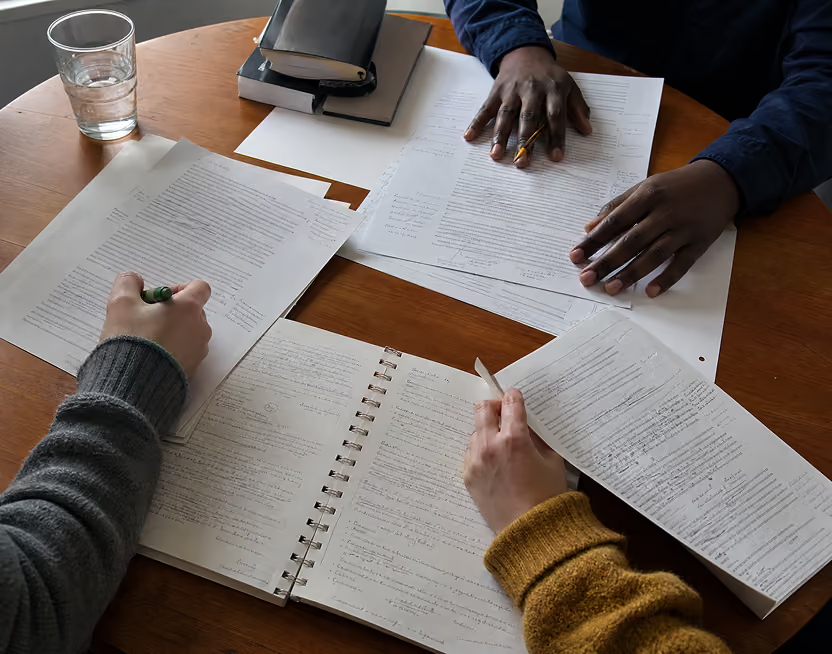
CPA members sharing handwritten notes around a table
Thinking Space
Climate and ecological emotions
Climate justice & decolonising

Hosting and facilitating a Climate café listening circle (CCLC) training

Do you want to help build resilience in your community? Climate Cafe LIstening Circle (CCLC) Training builds the confidence, skills, and peer community to facilitate your own circles. Delivered as a structured programme over three sessions in closed cohorts, with ongoing supervision and support afterwards.

Wet garden path through lush greenery

The Climate Crisis Digest is our monthly publication, usually a short piece written by members.

The name Digest reflects the psychoanalyst Wilfred Bion's insight that experience needs to be digested in order to be thinkable, especially when it is hard to bear (hence CPA's approach to difficult truths). The Digest style is not academic or polemical, more journalistic and exploratory in tone. That requires reflection by the author, to invite reflection in readers. Reflection here means inquiring into our emotional experience so as to more fully engage with the meaning of what is written.

The Digest is edited by Thulsi Prabakaran.

Subscribe to our newsletter.

All news posts

Our library is a collection of open-access research and resources, written or recommended by CPA members.

Displaying
1
of
1
articles
Thank you! Your submission has been received!
Oops! Something went wrong while submitting the form.
Climate justice & decolonising
Therapeutic perspectives

Contemporary responses in Africa to the aftermath of death: developments and decolonising challenges

From Mortality 30(2), 355-376 (Open Access): Despite death and bereavement studies being dominated by scholars and empirical material from Europe and North America, death and bereavement studies have often assumed the universality of their knowledge claims. This article explores what innovative insights can be gained about death and its aftermath from contemporary research in African contexts - South Sudan, Senegal, and Uganda - with diverse histories of colonialism and contemporary experiences of marginalisation, as well as activism against political, economic and epistemic injustices. The authors illustrate how the process of decolonising death and knowledge about death has long, historical roots that can be traced back to acts of resistance during the colonial period, and question dominant post/neo-colonial development discourses that focus solely on the material impact of death as a 'household shock'.

2025
Research papers
Nannyonga-Tamusuza
Contemporary responses in Africa to the aftermath of death: developments and decolonising challenges
Nannyonga-Tamusuza
2025
Parenting
Activism & collective action
Climate and ecological emotions

Voice 6: Becoming an Activist Parent

A parent describes a sudden moment of climate anxiety in February 2019, staring into a future in which she was unable to feed or keep her children safe.

2024
Books & chapters
Voice 6: Becoming an Activist Parent
Naldrett
2024
Theory and frameworks
Activism & collective action

An Integrative Methodology for Investigating Lived Experience and the Psychosocial Factors Influencing Environmental Cognition and Behaviour

This chapter describes an integrative research methodology for investigating lived experience and the psychosocial factors influencing environmental cognition and behaviour, developed to study sustainability professionals working to influence pro-environmental decision-making within their organisations. The methodology combines Interpretative Phenomenological Analysis with frame and metaphor analysis, drawing on systems thinking and theories of psychological threat, coping, needs, emotion and embodied cognition. Findings show that emotion regulation is a significant coping strategy that can both support and hinder pro-environmental action, and that avoidance of negative emotions, while offering temporary psychological relief, can ultimately produce maladaptive responses to ecological crisis.

2019
Books & chapters
Nadine Andrews
An Integrative Methodology for Investigating Lived Experience and the Psychosocial Factors Influencing Environmental Cognition and Behaviour
Andrews
2019
Climate justice & decolonising
Theory and frameworks
Denial & avoidance
Nature connection
Climate and ecological emotions

How Integrative Psychotherapy Can Address the Anthropocene Crisis

This paper addresses how and why the human species considers itself separate from ecosystems, and what needs to shift in our thinking so that we can be part of, rather than split off from, the more-than-human world. Four clinical vignettes — including the famous case of Joanna Macy, whose therapist interpreted her outrage over old-growth forest destruction as displaced sexual anxiety — illustrate the interplay between 'eco' and 'psycho' in the clinical context. Drawing on Hawkins and Ryde's Ecological Awareness Cycle, Mowat argues that psychotherapy training urgently needs to incorporate ecosystemic thinking, framing the climate and ecological crisis as a social justice and diversity issue requiring inclusion in UKCP Standards of Education and Training.

2021
Articles & reflections
Brigitta Mowat
How Integrative Psychotherapy Can Address the Anthropocene Crisis
Mowat
2021
Therapeutic perspectives
Climate justice & decolonising

Climate Change on the Couch: How Psychotherapy Can Respond to the Climate and Ecological Emergency – and Why It Should (Part 1)

ABSTRACT: This paper considers the position of the counselling and psychotherapy profession within the context of the Climate and Ecological Emergency (CEE) and the profession's responsibility in addressing it. The paper frames the CEE as a social justice issue driven by power structures such as colonialism, oppression and capitalism, which has its roots in intersubjective dynamics that must be addressed by the profession. The paper takes the view that the profession is part of the social ecosystem and must therefore take an active stance in beginning to question its own position and complicity in the CEE. Using an interpretative phenomenological approach (IPA), six counsellors and psychotherapists in the United Kingdom concerned about the CEE were interviewed to explore their personal thoughts and feelings and how it manifested in their clinical work. Socio-cultural and political issues in therapy and therapy training, difficulties in clinical work, and the need for sustainable thinking in the profession were identified. In arguing for an ecosystemic approach to counselling and psychotherapy — where the relational space is expanded to include extra-psychic realities — this paper bases its reasoning for new approaches on themes identified in the interviews.

2022
Articles & reflections
Brigitta Mowat
Climate Change on the Couch: How Psychotherapy Can Respond to the Climate and Ecological Emergency – and Why It Should (Part 1)
Mowat
2022
Therapeutic perspectives
Climate justice & decolonising

Climate Change on the Couch: How Psychotherapy Can Respond to the Climate and Ecological Emergency – and Why It Should (Part 2)

ABSTRACT: This is Part 2 of 'Climate Change on the Couch' (Mowat, 2022). It considers how the counselling and psychotherapy profession could be preparing trainees to support clients presenting climate-related issues such as distress or trauma. The paper expands on the theme of framing the Climate and Ecological Emergency (CEE) as a social-justice issue by looking at it through an environmental intersectional lens, whereby our relationship with each other and the environment is seen as an intersectional emergency. Applying an interpretive phenomenological (IPA) approach, six counsellors and psychotherapists concerned about the CEE were interviewed to explore their personal thoughts and feelings, and how the CEE manifests in their clinical work. This paper offers a theoretical underpinning for two domains identified in the interviews: (1) Perception of past, present and future in relation to life on the planet; and (2) Why it is difficult to think and talk about the CEE.

2023-4
Articles & reflections
Brigitta Mowat
Climate Change on the Couch: How Psychotherapy Can Respond to the Climate and Ecological Emergency – and Why It Should (Part 2)
Mowat
2023
Theory and frameworks
Climate and ecological emotions
Activism & collective action

Voice 4: Timothy Morton - Talking about Climate Agony, Trauma and Activism

A short conversation with philosopher Timothy Morton, known for developing the term 'hyperobject' in relation to climate change, discussing climate agony, trauma and activism with Caroline Hickman.

2024
Books & chapters
Voice 4: Timothy Morton - Talking about Climate Agony, Trauma and Activism
Morton
2024
Therapeutic perspectives
Theory and frameworks
Climate and ecological emotions

Climate Distress through the Lens of the Power Threat Meaning Framework

In this chapter, the different elements of the Power Threat Meaning Framework are described as they might relate to people distressed about climate breakdown within the UK. Example questions are offered that therapists might use to support narrative development; the author concludes with thoughts regarding therapeutic utility.

2024
Books & chapters
Gareth Morgan
Climate Distress through the Lens of the Power Threat Meaning Framework
Morgan
2024
Climate justice & decolonising
Climate and ecological emotions
Policy

Temperature and place associations with Inuit mental health in the context of climate change

This study examines associations between air temperature variables and mental health-related community clinic visits across Nunatsiavut, Labrador, Canada, finding that longer periods of warm temperatures significantly increased mental health clinic visits. Temperature-mental health associations aligned with community participation in land-based activities, and the strength of associations varied by place - suggesting that geography and local context modify how climate change affects mental health. The authors argue that place-based approaches are essential to health policy, planning, adaptation and research responding to climate change in the Circumpolar North.

2021
Research papers
Temperature and place associations with Inuit mental health in the context of climate change
Middleton
2021

Join our community of thinkers, researchers, and reflective practitioners

CPA is more than a publisher or a library. We're a working community of people thinking together about climate psychology. Our members participate in regular Thinking Spaces, contribute to research groups, edit the Explorations in Climate Psychology Journal, maintain the library, and bring their own work into shared conversation. Research at CPA is collaborative, generative, and grounded in practice.

Why join:

  • Monthly Thinking Space

  • Research Group

  • Opportunities to Publish

  • Intergenerational buddying

  • Student and Young Members Group

  • Opportunities to Publish

House with lit windows under a sunset sky