

Research and resources, shaped by those doing the work

Dark woodland in evening light
Unfurling fern frond

We're a community of researchers, practitioners, and thinkers committed to disseminating climate psychology widely, not just within our own professional circles. Through our flagship journal Explorations in Climate Psychology, our podcasts and talks, our library, and the contributions of members from across the world, we work to build a shared understanding of how psychology can meet this moment.

Explorations in Climate Psychology - the CPA journal

Navigating the inner and external work (relational and socio-political) that this moment calls on us to do, Explorations in Climate Psychology is CPA's flagship journal, published annually. We aim to be inclusive of the different ways people experience and engage with the climate and ecological crisis and welcome a wide range of forms: peer-reviewed research, analytical articles, reviews, interviews, reflections, testimonies, poetry, art, and lightly edited conversations.

Edited by CPA's Explorations Group, the journal explores current and emerging themes in the field, from climate grief and trauma to colonialism, decolonisation, the limits of Western rationality, and what it means to "stay with the trouble." The current editors of Explorations are noted in the latest issue.
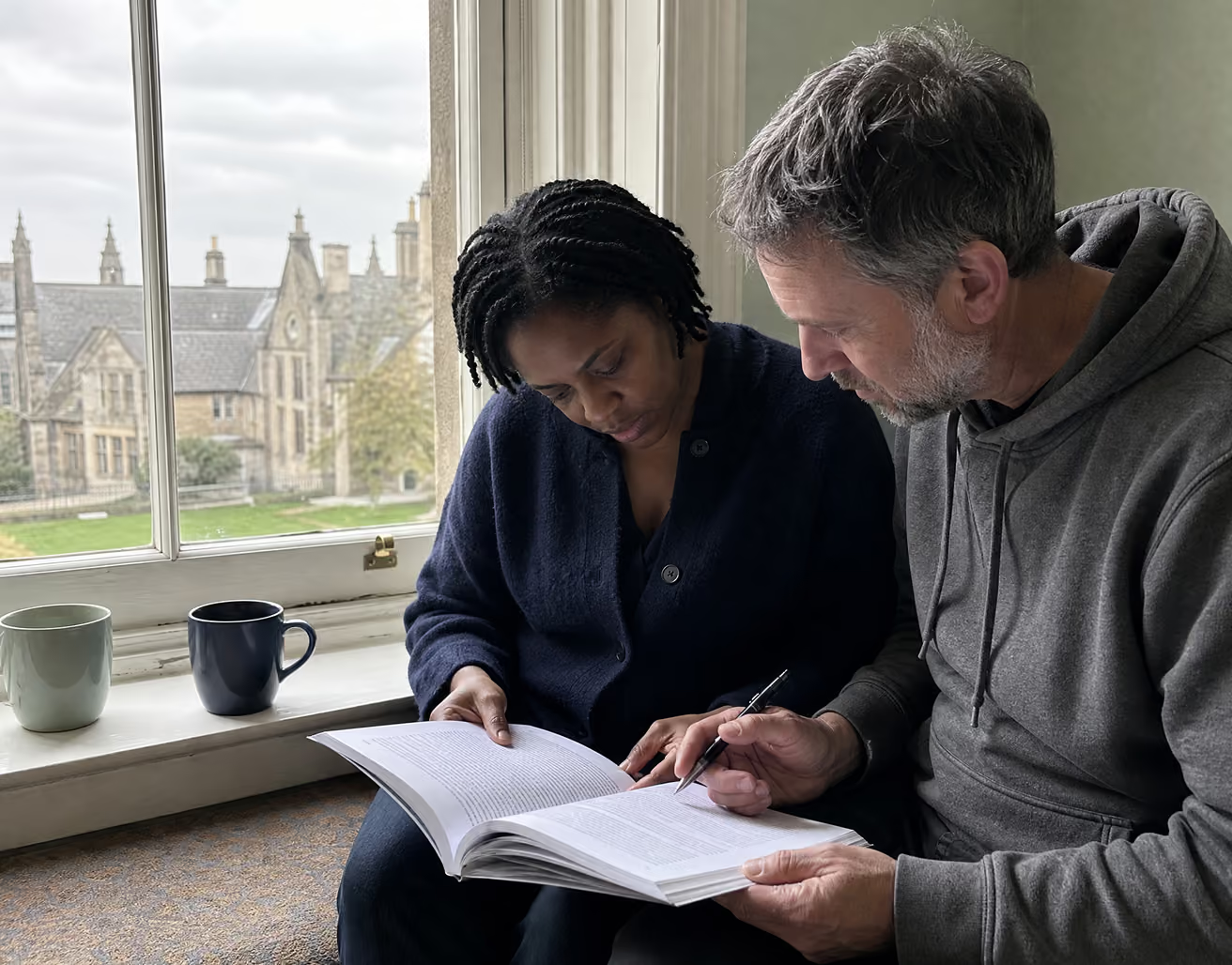

Two people reading an issue of the Explorations in Climate Psychology journal together
Three people researching together at a table with laptops and notes

We welcome contributions from inside and outside the CPA Community.

Find the latest call out here and guidelines for contributions here. The journal is open access and contributions can be used and quoted as long as they are referenced.

The Explorations group also offers online events with authors and other leading voices, which explore journal topics further.

See what's coming up

If you are interested in joining the editorial team (we particularly welcome young people and those of the Global Majority),  or wish to get in touch for another reason you can email them here.

A journal of climate psychology

Published regularly, featuring essays, research, and creative work from contributors across the UK and internationally. Each issue explores innovative forms of thinking and writing, navigating the relational and socio-political dimensions of the climate and ecological crisis.

Latest issue: Heavy weather: Exploring reactionary states of mind

Issue 8 is out now. In it you'll find explorations of the post-truth world, group narcissism, the unconscious, AI and power, and how these contribute to the reactionary state of mind.

Explorations: A journal of Climate Psychology

Published regularly, featuring essays, research, and creative work from contributors across the UK and internationally. Each issue explores innovative forms of thinking and writing, navigating the relational and socio-political dimensions of the climate and ecological crisis.

We also publish pieces from our journal via our Substack account. You can connect with us there, just follow @climatepsychologyexplorations on Substack.

New to Climate Psychology? Start here

Climate psychology is a young field with deep roots. If you're new to it, the resources below are good places to begin: foundational guides, podcasts and videos, defining texts, and the essential reading that practitioners and researchers return to again and again.

Hands resting on a book beside a mug and reading glasses
Three people in discussion around a coffee table

The Handbook of Climate Psychology

CPA's foundational guide to the field, freely available to download. The handbook introduces the key concepts, frameworks, and questions that shape climate psychology, and is used widely as an entry point for practitioners, researchers, and the curious.

Free Open University course

Introducing Climate Psychology: facing the climate crisis

The course explores ideas from social theory, psychoanalysis, ecopsychology, eco-feminism and post-humanism to gain a deeper understanding of the climate and ecological crisis, its impact on our wellbeing and how to build psychological resilience. The course is endorsed and supported by the CPA.

Climate Crisis Conversations

Our podcasts offers an accessible, conversational entry point into climate psychology, featuring CPA practitioners, researchers, and friends in dialogue about the climate and biodiversity crisis and the full range of emotional responses to it.

Deep questioning - navigating youth in a time of climate change

The power of art in helping us to 'see' climate change

Talking with children about climate change

What our members are sharing

Climate psychology is built collaboratively, by members for members and beyond. The work below reflects what people across our community are thinking about, researching, writing, and making right now. These are member contributions, not CPA publications, voices from across the alliance.

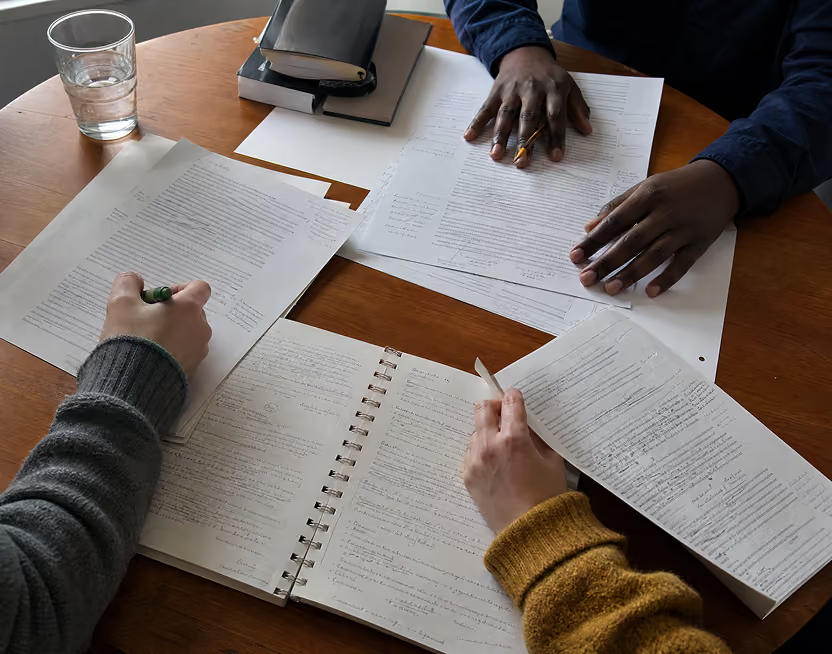
CPA members sharing handwritten notes around a table
Thinking Space
Climate and ecological emotions
Climate justice & decolonising

Hosting and facilitating a Climate café listening circle (CCLC) training

Do you want to help build resilience in your community? Climate Cafe LIstening Circle (CCLC) Training builds the confidence, skills, and peer community to facilitate your own circles. Delivered as a structured programme over three sessions in closed cohorts, with ongoing supervision and support afterwards.

Wet garden path through lush greenery

The Climate Crisis Digest is our monthly publication, usually a short piece written by members.

The name Digest reflects the psychoanalyst Wilfred Bion's insight that experience needs to be digested in order to be thinkable, especially when it is hard to bear (hence CPA's approach to difficult truths). The Digest style is not academic or polemical, more journalistic and exploratory in tone. That requires reflection by the author, to invite reflection in readers. Reflection here means inquiring into our emotional experience so as to more fully engage with the meaning of what is written.

The Digest is edited by Thulsi Prabakaran.

Subscribe to our newsletter.

All news posts

Our library is a collection of open-access research and resources, written or recommended by CPA members.

Displaying
1
of
1
articles
Thank you! Your submission has been received!
Oops! Something went wrong while submitting the form.
Therapeutic perspectives
Nature connection
Theory and frameworks
Denial & avoidance

Climate on the couch

2008
Research papers
Climate on the couch
Rust
2008
Youth & intergenerational
Climate and ecological emotions

Eco Distress: For Young People

Web resource from the Royal College of Psychiatrists aimed at young people, helping them understand climate-related distress and offering tools to feel better and take action.

Tools & guides
Royal College of Psychiatrists
Eco Distress: For Young People
Royal College of Psychiatrists
Theory and frameworks
Policy
Denial & avoidance

Security, Masculinity and the Fracking Debate

Responding to George Monbiot's suggestion that we consider the psychological motivations of fracking enthusiasts, Randall argues the language of the fracking debate is determinedly and demeaningly masculine - a macho fixation shared with other large engineering projects (nuclear power, space exploration) that chimes with corporate desire to invest large sums, and links this to government rhetoric framing fracking in terms of energy security.

2013
Articles & reflections
Rosemary Randall
Security, Masculinity and the Fracking Debate
Randall
2013
Therapeutic perspectives
Theory and frameworks
Climate and ecological emotions

Hungry Ghosts: Psychotherapy, control and the winds of homecoming

Drawing on Gregory Bateson's concept of epistemology and Jerome Bernstein's work on collective trauma, Robertson explores how what he calls 'hungry ghosts' - unmet needs and unprocessed collective or trans-generational trauma - surface in the therapy room, often mistaken by clients for purely personal history. He describes a clinical vignette in which attending to his own felt sense of grief and 'soul-making', rather than directing the client verbally, allowed a shift to occur. Robertson argues that Western individualism makes it easy to locate collective phenomena within one's own life story, exacerbating personal pain, and that psychotherapy faces a choice: continue domesticating clients' distress within existing cultural norms, or undergo its own 'deconstruction' to open space for renewal. Note: this excerpt draws on retrieved passages rather than confirmed opening paragraphs; worth checking against the full text.

2014
Research papers
Chris Robertson
Hungry Ghosts: Psychotherapy, control and the winds of homecoming
Robertson
2014
Therapeutic perspectives
Climate and ecological emotions
Hope & resilience

The Psychological Work of Being with the Climate Crisis

This chapter focuses on the psychological work involved in addressing collective symptoms such as eco-anxiety, disorientation, terror, despair, helplessness and rage as humanity crosses a geological and cultural threshold into the Anthropocene. Drawing particularly on the Climate Psychology Alliance's 'Through the Door' workshop, running since 2018, the chapter outlines how psychotherapists and other professionals struggling with incapacity and helplessness have been supported, and shares therapeutic practices especially fit for this uncertain time.

2024
Books & chapters
Chris Robertson
The Psychological Work of Being with the Climate Crisis
Robertson
2024
Nature connection
Theory and frameworks
Climate and ecological emotions

Ecopsychology's Wilding

In this review essay, Robertson engages with Nick Totton's Wild Therapy, exploring the historical, anthropological, political and psychological background to contemporary culture's loss of wildness, both internal and external. Rather than attempting an overarching unified theory for ecopsychology, Robertson notes, Totton instead weaves the notion of 'wildness' into a subtle and complex web that challenges core cultural assumptions - and argues that psychotherapy taking up these challenges seriously would return the profession to its more radical roots. Robertson considers what this reframing of wildness demands of psychotherapeutic practice and of practitioners themselves, situating Totton's framework within the wider development of ecopsychology as a field.

2013
Research papers
Chris Robertson
Ecopsychology's Wilding
Robertson
2013
Creative practice
Hope & resilience

A Journey to the Lush Isle: Collaboration with Lain Burgos-Lovece and Tali Sarnetzky

'Journey to the Lush Isle' is the first 'Small Forms' pamphlet created by Unpsychology contributors Lain Burgos-Lovece, Tali Sarnetzky and Chris Robertson (former CPA Chair, 2018-2020), with a fourth collaborator, Jo Regan, whose influence lingered in the words despite leaving the group early in the conversation. The pamphlet is a mix of conversation, commentary, imagination and story, at times reading like a tale from the future and at others like a warning in the here-and-now; throughout, it holds grief and grounded hope and beauty together.

Feb 2026
Articles & reflections
Chris Robertson
A Journey to the Lush Isle: Collaboration with Lain Burgos-Lovece and Tali Sarnetzky
Robertson
2026
Climate and ecological emotions
Theory and frameworks

Climate Shadow: Weathering Hate and Love

Sickness, disillusion, loss and existential dreadIn the preparation for writing, I became sick. Perhaps like Bob Dylan sings, I was 'sick of love' but also subject to the toxicity in the darkness of the subject matter. My ambivalence to engaging is as much an aspect of the journey as the cognitive exploration. It is a transference to the material. It is dangerous and I have suffered in previous engagements. And it is the nature of such enquiries that they involve attempting to digest what has previously seemed poisonous.

2025
Articles & reflections
Chris Robertson
Climate Shadow: Weathering Hate and Love
Robertson
2025
Theory and frameworks
Denial & avoidance
Climate and ecological emotions

Being on the Cusp: Facing Psychological Impasse (part 2)

Continuing directly from part 1, Robertson extends Winnicott's concept of the 'false self' - a defensive retreat from reality and external pressure - to what he terms a collective 'False World': a cultural fantasy of separation from ecological limits, exemplified by notions of escaping to other planets rather than reckoning with life on this one. He argues that relinquishing this false world is difficult precisely because so much has been invested in maintaining it. Drawing on the bidirectional coupling between earth systems and human social systems, Robertson explores how climate science's early focus on human impacts on the planet has increasingly given way to recognising feedback effects on humans themselves - forced migration, disease, infertility, conflict - and situates eco-anxiety within this entanglement as a complex mix of care, grief and complicity that can act as a catalyst for change rather than only a source of paralysis. The essay closes by considering what psychological and cultural practices might support staying at this 'cusp' rather than retreating from it, drawing on Hillman, Baldwin, and contemporary climate psychology research on young people's climate anxiety and moral injury.

2023
Articles & reflections
Chris Robertson
Being on the Cusp: Facing Psychological Impasse (part 2)
Robertson
2023

Join our community of thinkers, researchers, and reflective practitioners

CPA is more than a publisher or a library. We're a working community of people thinking together about climate psychology. Our members participate in regular Thinking Spaces, contribute to research groups, edit the Explorations in Climate Psychology Journal, maintain the library, and bring their own work into shared conversation. Research at CPA is collaborative, generative, and grounded in practice.

Why join:

  • Monthly Thinking Space

  • Research Group

  • Opportunities to Publish

  • Intergenerational buddying

  • Student and Young Members Group

  • Opportunities to Publish

House with lit windows under a sunset sky