

Research and resources, shaped by those doing the work

Dark woodland in evening light
Unfurling fern frond

We're a community of researchers, practitioners, and thinkers committed to disseminating climate psychology widely, not just within our own professional circles. Through our flagship journal Explorations in Climate Psychology, our podcasts and talks, our library, and the contributions of members from across the world, we work to build a shared understanding of how psychology can meet this moment.

Explorations in Climate Psychology - the CPA journal

Navigating the inner and external work (relational and socio-political) that this moment calls on us to do, Explorations in Climate Psychology is CPA's flagship journal, published annually. We aim to be inclusive of the different ways people experience and engage with the climate and ecological crisis and welcome a wide range of forms: peer-reviewed research, analytical articles, reviews, interviews, reflections, testimonies, poetry, art, and lightly edited conversations.

Edited by CPA's Explorations Group, the journal explores current and emerging themes in the field, from climate grief and trauma to colonialism, decolonisation, the limits of Western rationality, and what it means to "stay with the trouble." The current editors of Explorations are noted in the latest issue.
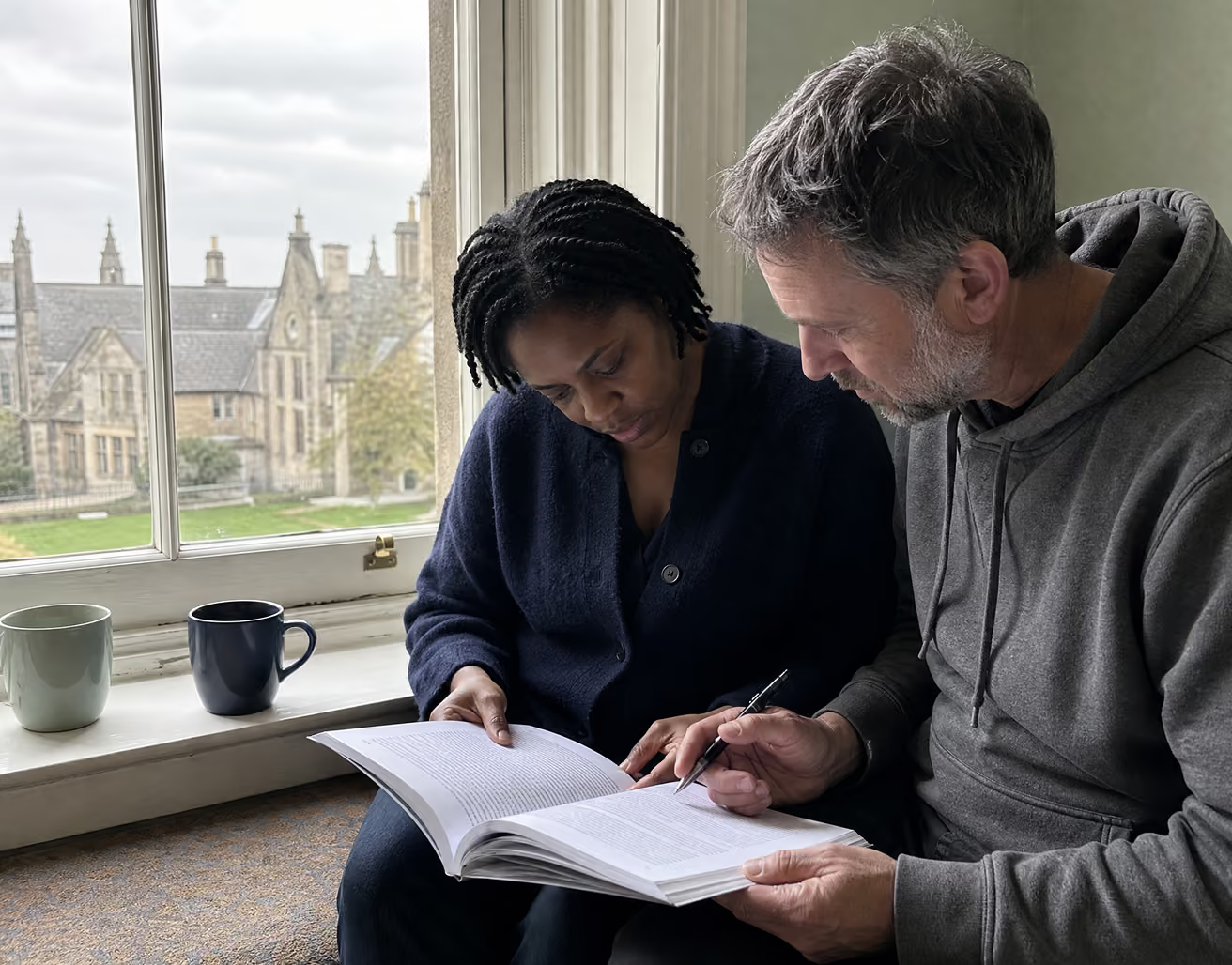

Two people reading an issue of the Explorations in Climate Psychology journal together
Three people researching together at a table with laptops and notes

We welcome contributions from inside and outside the CPA Community.

Find the latest call out here and guidelines for contributions here. The journal is open access and contributions can be used and quoted as long as they are referenced.

The Explorations group also offers online events with authors and other leading voices, which explore journal topics further.

See what's coming up

If you are interested in joining the editorial team (we particularly welcome young people and those of the Global Majority),  or wish to get in touch for another reason you can email them here.

A journal of climate psychology

Published regularly, featuring essays, research, and creative work from contributors across the UK and internationally. Each issue explores innovative forms of thinking and writing, navigating the relational and socio-political dimensions of the climate and ecological crisis.

Latest issue: Heavy weather: Exploring reactionary states of mind

Issue 8 is out now. In it you'll find explorations of the post-truth world, group narcissism, the unconscious, AI and power, and how these contribute to the reactionary state of mind.

Explorations: A journal of Climate Psychology

Published regularly, featuring essays, research, and creative work from contributors across the UK and internationally. Each issue explores innovative forms of thinking and writing, navigating the relational and socio-political dimensions of the climate and ecological crisis.

We also publish pieces from our journal via our Substack account. You can connect with us there, just follow @climatepsychologyexplorations on Substack.

New to Climate Psychology? Start here

Climate psychology is a young field with deep roots. If you're new to it, the resources below are good places to begin: foundational guides, podcasts and videos, defining texts, and the essential reading that practitioners and researchers return to again and again.

Hands resting on a book beside a mug and reading glasses
Three people in discussion around a coffee table

The Handbook of Climate Psychology

CPA's foundational guide to the field, freely available to download. The handbook introduces the key concepts, frameworks, and questions that shape climate psychology, and is used widely as an entry point for practitioners, researchers, and the curious.

Free Open University course

Introducing Climate Psychology: facing the climate crisis

The course explores ideas from social theory, psychoanalysis, ecopsychology, eco-feminism and post-humanism to gain a deeper understanding of the climate and ecological crisis, its impact on our wellbeing and how to build psychological resilience. The course is endorsed and supported by the CPA.

Climate Crisis Conversations

Our podcasts offers an accessible, conversational entry point into climate psychology, featuring CPA practitioners, researchers, and friends in dialogue about the climate and biodiversity crisis and the full range of emotional responses to it.

Deep questioning - navigating youth in a time of climate change

The power of art in helping us to 'see' climate change

Talking with children about climate change

What our members are sharing

Climate psychology is built collaboratively, by members for members and beyond. The work below reflects what people across our community are thinking about, researching, writing, and making right now. These are member contributions, not CPA publications, voices from across the alliance.

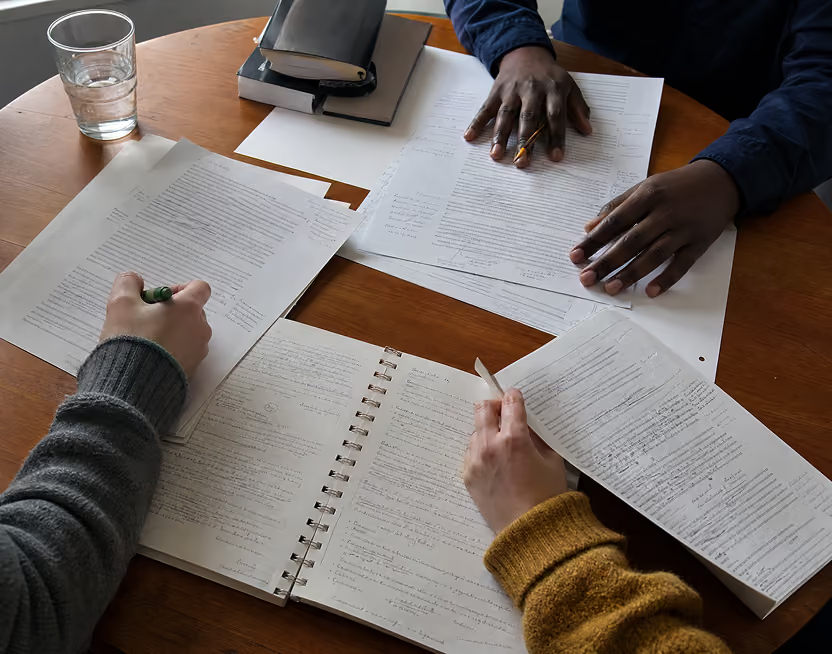
CPA members sharing handwritten notes around a table
Thinking Space
Climate and ecological emotions
Climate justice & decolonising

Hosting and facilitating a Climate café listening circle (CCLC) training

Do you want to help build resilience in your community? Climate Cafe LIstening Circle (CCLC) Training builds the confidence, skills, and peer community to facilitate your own circles. Delivered as a structured programme over three sessions in closed cohorts, with ongoing supervision and support afterwards.

Wet garden path through lush greenery

The Climate Crisis Digest is our monthly publication, usually a short piece written by members.

The name Digest reflects the psychoanalyst Wilfred Bion's insight that experience needs to be digested in order to be thinkable, especially when it is hard to bear (hence CPA's approach to difficult truths). The Digest style is not academic or polemical, more journalistic and exploratory in tone. That requires reflection by the author, to invite reflection in readers. Reflection here means inquiring into our emotional experience so as to more fully engage with the meaning of what is written.

The Digest is edited by Thulsi Prabakaran.

Subscribe to our newsletter.

All news posts

Our library is a collection of open-access research and resources, written or recommended by CPA members.

Displaying
1
of
1
articles
Thank you! Your submission has been received!
Oops! Something went wrong while submitting the form.
Hope & resilience
Theory and frameworks
Therapeutic perspectives

Everything and Nothing: Essays on Climate Change and Cultural Transformation

A collection of essays on climate change and cultural transformation, drawing on psychotherapy, Buddhist and other contemplative traditions, and the history of ideas. The title essay, 'Everything and Nothing: Radical Hope in a Time of Climate Change' (originally a CPA paper), considers Jonathan Lear's concept of radical hope alongside Buddhist teachings on emptiness, asking whether contemplative practice can support engagement with the climate crisis without collapsing into denial or despair.

2022
Books & chapters
Tony Cartwright
Everything and Nothing: Essays on Climate Change and Cultural Transformation
Cartwright
2022
Climate and ecological emotions

Anxious and egocentric: How specific emotions influence perspective taking

Though not a climate-focused study, this widely-cited experimental psychology paper investigates how incidental experiences of anxiety shape perspective-taking, finding that anxious participants show greater egocentrism in mental-state reasoning than those experiencing other negative emotions such as anger or disgust, or neutral states. Anxious participants were more likely to rely on their own spatial and conceptual perspective when reasoning about others, an effect explained in part by heightened uncertainty appraisal. Retained in this library as a relevant theoretical reference point: the finding that anxiety specifically (rather than negative affect generally) narrows perspective-taking capacity has direct relevance for understanding how climate anxiety might affect empathy, intergenerational understanding, and collective action, even though the original study does not address climate change directly.

2015
Research papers
Anxious and egocentric: How specific emotions influence perspective taking
Todd
2015
Youth & intergenerational
Climate and ecological emotions

The Triple Wellbeing Book

Free-to-download book developed by Thought Box, supporting teachers to meet children and young people's emotional needs while educating them about the climate crisis.

Books & chapters
Thought Box
The Triple Wellbeing Book
Thought Box
Youth & intergenerational
Climate justice & decolonising
Climate and ecological emotions

For Teachers: An Existential Tool Kit

Podcast episode discussing the Existential Toolkit for Climate Justice Educators and the emotional, political, personal and pedagogical challenges teachers face in the context of climate change.

Podcasts & talks
Thomas Doherty
For Teachers: An Existential Tool Kit
Doherty
Climate and ecological emotions
Hope & resilience
Activism & collective action

How to cope with climate anxiety and take action

From Psyche Guides: While anxiety about the climate crisis can be rational and even adaptive for most people, sometimes it can become pervasive and incapacitating. This burdensome form of climate anxiety can lead to feelings of helplessness and hopelessness, causing intense suffering and potentially even deterring one from taking action in pursuit of climate solutions (what some have called 'eco-paralysis'). Structural change is the real solution for climate anxiety, but as people work together to achieve that, we can also focus on building emotional resilience. Strategies include getting a better understanding of what you're feeling, calming your body when it's in a state of alarm, tackling unhelpful thoughts and media usage, seeking safe spaces to explore feelings, and taking collective action and building community.

n.d.
Articles & reflections
How to cope with climate anxiety and take action
Tecuta
Parenting
Youth & intergenerational

How to Talk to Kids About Climate Change

Article and podcast episode with advice from senior psychologist Susie Burke on talking to children about climate change.

2019
Articles & reflections
Susie Burke
Australian Psychological Society
How to Talk to Kids About Climate Change
Burke
2019
Climate justice & decolonising
Theory and frameworks

The unbearable heaviness of climate coloniality

This invited paper for the 40th anniversary of Political Geography coins the concept of 'climate coloniality' to name how the extremely uneven and inequitable impacts of climate change mean that differently-located people experience, respond to, and cope with the crisis in radically different ways. Sultana argues that coloniality seeps through everyday life across space and time, curtailing opportunities and possibilities through global racial capitalism, colonial dispossession, and climate debts, and that decolonising climate requires addressing both epistemic violence and material outcomes rather than treating the crisis as a politically neutral, purely technical problem. The paper argues that genuinely decolonising climate action must engage with the complexities of colonialism, imperialism, capitalism and geopolitics embedded in existing global governance structures, discursive framings, and proposed solutions.

2022
Research papers
Farhana Sultana
The unbearable heaviness of climate coloniality
Sultana
2022
Hope & resilience
Denial & avoidance
Activism & collective action

Rejecting Climate Doomism

As scientists call for widespread climate action, this book responds to an alarming rise in climate doomism - the belief that it is too late to do anything about climate change, which leads many people to look away and do nothing, immobilised by defeatist thinking. Drawing from climate science, sociology, psychology and philosophy, Stuart argues that every fraction of a degree of warming avoided means saving lives and livelihoods, and outlines reasons to choose action grounded in active hope instead. The book examines specific policy proposals for effectively limiting global warming, the psychology of motivating climate action and collective action, and closes by outlining a positive vision of the far-reaching social and economic changes needed to forge a better path for people and the planet.

2026
Books & chapters
Diana Stuart
Rejecting Climate Doomism
Stuart
2026
Theory and frameworks

The Anthropocene

This influential paper formalises the concept of the Anthropocene, the proposed epoch in which humans and human societies have become a global geophysical force comparable to natural forces that have shaped Earth's history. The authors trace the Anthropocene's origins to around 1800 with the onset of industrialisation and the massive expansion in fossil fuel use, using atmospheric carbon dioxide concentration as a simple tracking indicator, and describe the 'Great Acceleration' since 1950 during which human activity and its consequences for Earth system functioning have intensified dramatically. Now one of the most widely cited papers in climate and environmental science, it provides a foundational scientific frame that much subsequent climate psychology literature builds on or responds to.

2007
Research papers
Steffen, W.
Crutzen, P. J.
McNeill, J. R.
The Anthropocene
Steffen
2007

Join our community of thinkers, researchers, and reflective practitioners

CPA is more than a publisher or a library. We're a working community of people thinking together about climate psychology. Our members participate in regular Thinking Spaces, contribute to research groups, edit the Explorations in Climate Psychology Journal, maintain the library, and bring their own work into shared conversation. Research at CPA is collaborative, generative, and grounded in practice.

Why join:

  • Monthly Thinking Space

  • Research Group

  • Opportunities to Publish

  • Intergenerational buddying

  • Student and Young Members Group

  • Opportunities to Publish

House with lit windows under a sunset sky