

Research and resources, shaped by those doing the work

Dark woodland in evening light
Unfurling fern frond

We're a community of researchers, practitioners, and thinkers committed to disseminating climate psychology widely, not just within our own professional circles. Through our flagship journal Explorations in Climate Psychology, our podcasts and talks, our library, and the contributions of members from across the world, we work to build a shared understanding of how psychology can meet this moment.

Explorations in Climate Psychology - the CPA journal

Navigating the inner and external work (relational and socio-political) that this moment calls on us to do, Explorations in Climate Psychology is CPA's flagship journal, published annually. We aim to be inclusive of the different ways people experience and engage with the climate and ecological crisis and welcome a wide range of forms: peer-reviewed research, analytical articles, reviews, interviews, reflections, testimonies, poetry, art, and lightly edited conversations.

Edited by CPA's Explorations Group, the journal explores current and emerging themes in the field, from climate grief and trauma to colonialism, decolonisation, the limits of Western rationality, and what it means to "stay with the trouble." The current editors of Explorations are noted in the latest issue.
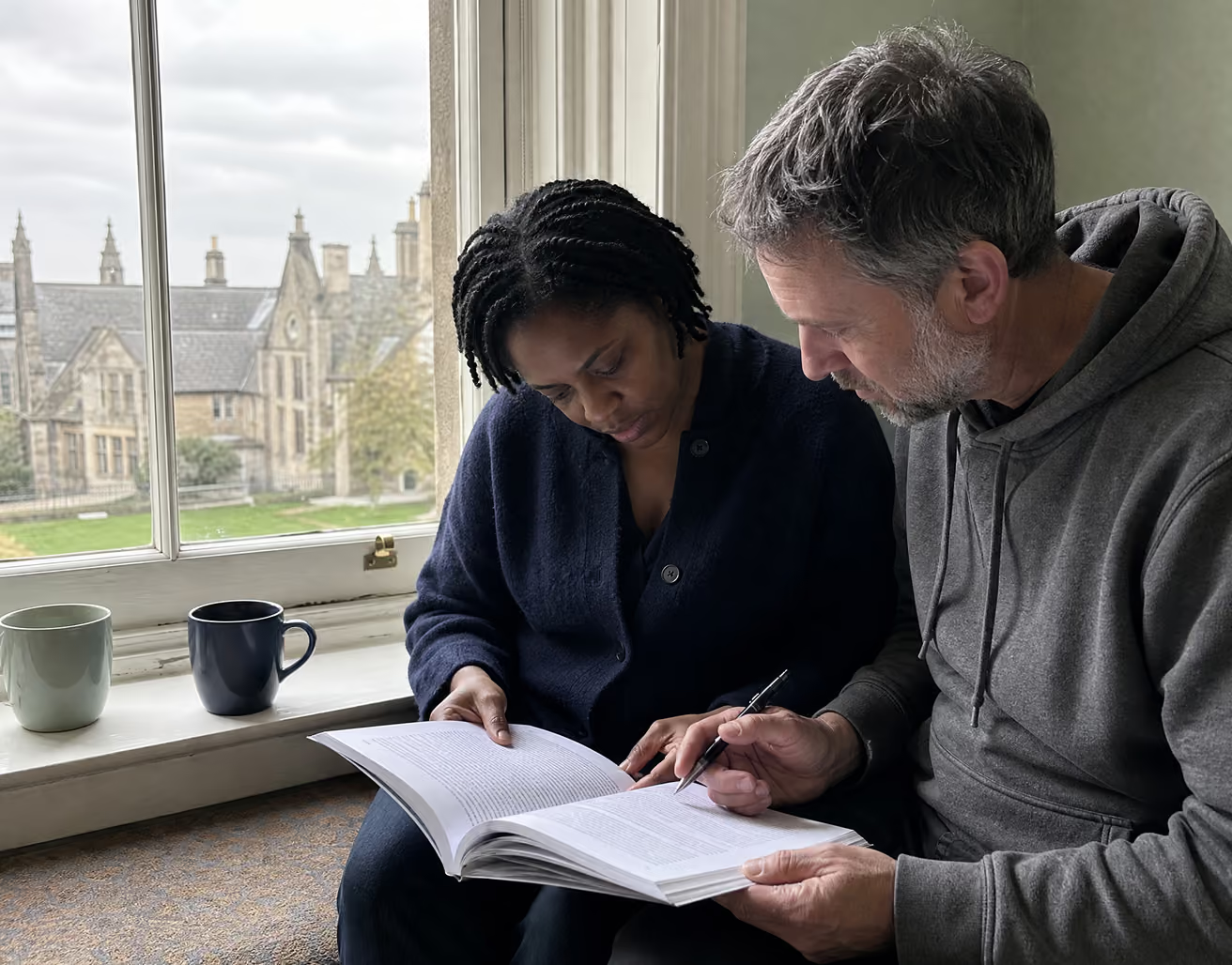

Two people reading an issue of the Explorations in Climate Psychology journal together
Three people researching together at a table with laptops and notes

We welcome contributions from inside and outside the CPA Community.

Find the latest call out here and guidelines for contributions here. The journal is open access and contributions can be used and quoted as long as they are referenced.

The Explorations group also offers online events with authors and other leading voices, which explore journal topics further.

See what's coming up

If you are interested in joining the editorial team (we particularly welcome young people and those of the Global Majority),  or wish to get in touch for another reason you can email them here.

A journal of climate psychology

Published regularly, featuring essays, research, and creative work from contributors across the UK and internationally. Each issue explores innovative forms of thinking and writing, navigating the relational and socio-political dimensions of the climate and ecological crisis.

Latest issue: Heavy weather: Exploring reactionary states of mind

Issue 8 is out now. In it you'll find explorations of the post-truth world, group narcissism, the unconscious, AI and power, and how these contribute to the reactionary state of mind.

Explorations: A journal of Climate Psychology

Published regularly, featuring essays, research, and creative work from contributors across the UK and internationally. Each issue explores innovative forms of thinking and writing, navigating the relational and socio-political dimensions of the climate and ecological crisis.

We also publish pieces from our journal via our Substack account. You can connect with us there, just follow @climatepsychologyexplorations on Substack.

New to Climate Psychology? Start here

Climate psychology is a young field with deep roots. If you're new to it, the resources below are good places to begin: foundational guides, podcasts and videos, defining texts, and the essential reading that practitioners and researchers return to again and again.

Hands resting on a book beside a mug and reading glasses
Three people in discussion around a coffee table

The Handbook of Climate Psychology

CPA's foundational guide to the field, freely available to download. The handbook introduces the key concepts, frameworks, and questions that shape climate psychology, and is used widely as an entry point for practitioners, researchers, and the curious.

Free Open University course

Introducing Climate Psychology: facing the climate crisis

The course explores ideas from social theory, psychoanalysis, ecopsychology, eco-feminism and post-humanism to gain a deeper understanding of the climate and ecological crisis, its impact on our wellbeing and how to build psychological resilience. The course is endorsed and supported by the CPA.

Climate Crisis Conversations

Our podcasts offers an accessible, conversational entry point into climate psychology, featuring CPA practitioners, researchers, and friends in dialogue about the climate and biodiversity crisis and the full range of emotional responses to it.

Can ancient myths help transform the narratives that led to the climate change crisis?

Climate Change: Finding the silver lining, part 1

Climate Change: Finding the silver lining, part 2

What our members are sharing

Climate psychology is built collaboratively, by members for members and beyond. The work below reflects what people across our community are thinking about, researching, writing, and making right now. These are member contributions, not CPA publications, voices from across the alliance.

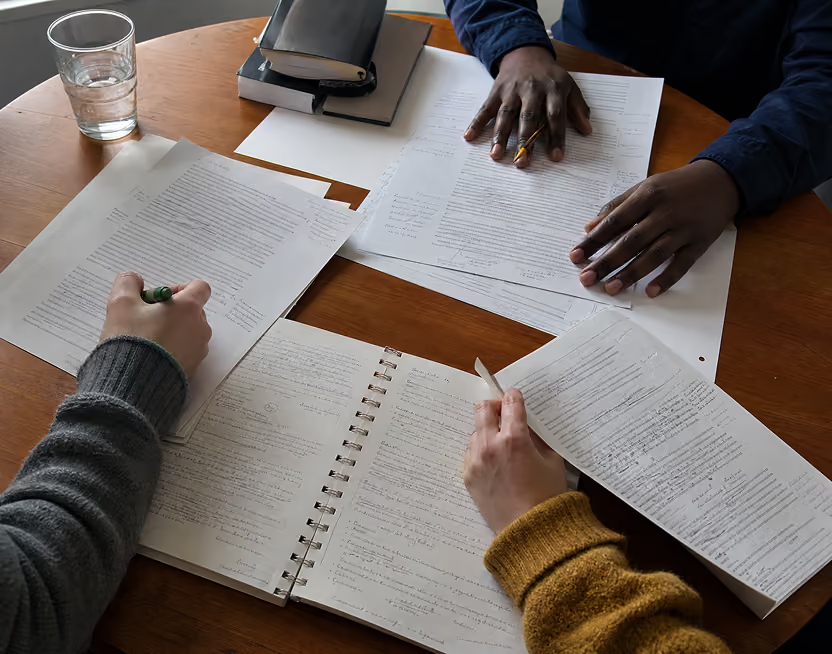
CPA members sharing handwritten notes around a table
Thinking Space
Climate and ecological emotions
Climate justice & decolonising

Hosting and facilitating a Climate café listening circle (CCLC) training

Do you want to help build resilience in your community? Climate Cafe LIstening Circle (CCLC) Training builds the confidence, skills, and peer community to facilitate your own circles. Delivered as a structured programme over three sessions in closed cohorts, with ongoing supervision and support afterwards.

Wet garden path through lush greenery

The Climate Crisis Digest is our monthly publication, usually a short piece written by members.

The name Digest reflects the psychoanalyst Wilfred Bion's insight that experience needs to be digested in order to be thinkable, especially when it is hard to bear (hence CPA's approach to difficult truths). The Digest style is not academic or polemical, more journalistic and exploratory in tone. That requires reflection by the author, to invite reflection in readers. Reflection here means inquiring into our emotional experience so as to more fully engage with the meaning of what is written.

The Digest is edited by Thulsi Prabakaran.

Subscribe to our newsletter.

All news posts

Our library is a collection of open-access research and resources, written or recommended by CPA members.

Displaying
1
of
1
articles
Thank you! Your submission has been received!
Oops! Something went wrong while submitting the form.
Climate and ecological emotions
Therapeutic Support
Activism & collective action

'Ways of Being' When Facing Difficult Truths: Exploring the Contribution of Climate Cafes to Climate Crisis Awareness

A climate cafe is a hospitable and empathic space where anxiety about the current crisis can be safely expressed and people can engage with difficult truths while staying connected and grounded. With emotionally containing structures in place, climate cafes allow participants to explore anger, helplessness, sadness, grief and depression without dissociating, numbing or going into blind panic, offering relief and a powerful sense of connection.

2024
Books & chapters
Gillian Broad
Ways of Being' When Facing Difficult Truths: Exploring the Contribution of Climate Cafes to Climate Crisis Awareness
Broad
2024
Climate and ecological emotions
Hope & resilience
Creative practice

Ecological Grief, Hope, and Creative Forms of Resilience: A Creative Practice Approach

With the effects of the climate emergency increasingly shaping our daily lives, feelings of ecological distress – particularly ecogrief and anxiety – have become palpable. In this article, we focus on these affective responses and examine how creative practice collaborations are curating possibilities for hope and resilience. We argue for the importance of such creative engagement, as ecological distress can lead to paralysis, nihilism, or despair, making it imperative to explore how creative practices open pathways for collective healing and actionable hope in the face of crisis.

2025
Research papers
Tamara Borovica
Jacina Leong
Jen Rae
Larissa Hjorth
Ecological Grief, Hope, and Creative Forms of Resilience: A Creative Practice Approach
Borovica
2025
Nature connection
Parenting
Therapeutic perspectives

Voice 10: Saving Our Children by Bringing Back Beavers

We are at such a pivotal moment in human existence that you cannot separate the holistic context of climate breakdown and the loss of human habitat from the psychotherapeutic treatment of anyone remotely aware of the climate emergency. What it means to be human and our relationship with other life is changing.

2024
Books & chapters
Voice 10: Saving Our Children by Bringing Back Beavers
Bishop
2024
Denial & avoidance
Theory and frameworks

No climate change salience in Lofoten fisheries? Climatic Change, 144(4), 565-572

In a recent article on climate change and recognition of the need for adaptation, Dannevig and Hovelsrud (Clim Chang 135:261–275, 2016) conclude that climate change is not salient in fisheries on the Lofoten Islands in Northern Norway. This commentary scrutinizes this conclusion. Empirical findings rather indicate that the Lofoten fishers do indeed frame climate change as a problem and acknowledge the need for adaptive response; however, mental barriers are likely to mask existing climate change salience. Based on the authors’ line of argument and insights from psychology, this contribution aims to extend their debate and stimulate discussion by drawing attention to the impacts of mental barriers. A particular focus is thereby laid on the role of cognitive dissonance and hard-wired emotions.

2017
Research papers
No climate change salience in Lofoten fisheries? Climatic Change, 144(4), 565-572
Bercht
2017
Theory and frameworks
Denial & avoidance
Activism & collective action

Tackling climate inaction: How a social identity approach matters to climate communication

We have reached a point where it is impossible to ignore climate change and its impacts - but this does not necessarily imply people are ready to act. As recent research shows, even when people are well-informed about climate change, appraise it as a current, visible, local and personal threat and express concern, their response in terms of facing challenges head on and translating their concern into climate-mitigative, adaptive and transformative behaviour seems restricted.How does this knowledge-action gap arise? Also, it is striking that people who initially state that they do not worry about climate change, later seemingly contradict themselves by saying the opposite: "I am extremely worried." Why is that?

2020
Research papers
Tackling climate inaction: How a social identity approach matters to climate communication
Bercht
2020
Theory and frameworks
Denial & avoidance
Climate and ecological emotions

Deep Adaptation: A Map for Navigating Climate Tragedy

The purpose of this conceptual paper is to provide readers with an opportunity to reassess their work and life in the face of an inevitable near term social collapse due to climate change. The approach of the paper is to analyse recent studies on climate change and its implications for our ecosystems, economies and societies, as provided by academic journals and publications direct from research institutes. That synthesis leads to a conclusion there will be a near term collapse in society with serious ramifications for the lives of readers. The paper reviews some of the reasons why collapse-denial may exist, in particular, in the professions of sustainability research and practice, therefore leading to these arguments having been absent from these fields until now. The paper offers a new meta-framing of the implications for research, organisational practice, personal development and public policy, called the Deep Adaptation Agenda. Its key aspects of resilience, relinquishment and restorations are explained.

2018
Research papers
Jem Bendell
Deep Adaptation: A Map for Navigating Climate Tragedy
Bendell
2018
Climate and ecological emotions
Denial & avoidance
Theory and frameworks

The responsibility of communicating difficult truths about climate influenced societal disruption and collapse

This paper presents a review of psychology research that can help people begin to assess the different ways they can responsibly support each other to talk about their thoughts and feelings on their perceptions of societal disruption and collapse, at home and abroad, due to environmental and climate change. It includes a summary of a review of published studies in psychology on matters of anticipating difficult futures, including vulnerability, disruption, disaster, suffering and mortality. The claims by both specialists and non-specialists that collapse anticipation is necessarily harmful to mental health and social engagement is shown to be theoretically and empirically weak. Instead, the research that suggests we engage each other on this upsetting topic to promote coping.

2021
Research papers
Jem Bendell
Kieft, J.
The responsibility of communicating difficult truths about climate influenced societal disruption and collapse
Bendell
2021
Therapeutic Support
Theory and frameworks
Climate and ecological emotions

Trauma, fragmentation and narrative: Sandor Ferenczi's relevance for psychoanalytical perspectives on our response to climate change and environmental destruction

Psychoanalytical perspectives on our responses to climate change and environmental destruction may be said to have begun with Harold Searles in 1972 and have gathered pace in recent years. All these explorations have in common a reliance on a set of conceptual ideas that were initially developed by Sandor Ferenczi, although he is rarely credited. Fully acknowledging of the extent of environmental destruction and climate change is seen as traumatic in these writings, and therefore, concepts that have been developed in working with patients traumatized by abuse have been found essential in trying to understand and describe our responses. This paper will show how Ferenczi's thinking about trauma and about the therapeutic relationship has influenced recent suggestions as to how a psychoanalytical perspective may help us to explore attitudes and beliefs and help others to fully acknowledge the seriousness of climate change and so change damaging behaviors.

2019
Research papers
Alan Bellamy
Trauma, fragmentation and narrative: Sandor Ferenczi's relevance for psychoanalytical perspectives on our response to climate change and environmental destruction
Bellamy
2019
Therapeutic perspectives
Theory and frameworks
Nature connection

How Wide is the Field? Psychotherapy, Capitalism and the More Than Human World

Climate change is no longer a hypothetical argument but a reality that threatens the existence of human and other-than-human life on the planet. With that information in mind, can we afford to keep practising psychotherapy with a focus on the individual and their personal needs, or do we need to radically question the role of psychotherapy in its lack of relationship to the more-than-human world?

2024
Books & chapters
Steffi Bednarek
How Wide is the Field? Psychotherapy, Capitalism and the More Than Human World
Bednarek
2024

Join our community of thinkers, researchers, and reflective practitioners

CPA is more than a publisher or a library. We're a working community of people thinking together about climate psychology. Our members participate in regular Thinking Spaces, contribute to research groups, edit the Explorations in Climate Psychology Journal, maintain the library, and bring their own work into shared conversation. Research at CPA is collaborative, generative, and grounded in practice.

Why join:

  • Monthly Thinking Space

  • Research Group

  • Opportunities to Publish

  • Intergenerational buddying

  • Student and Young Members Group

  • Opportunities to Publish

House with lit windows under a sunset sky