

Research and resources, shaped by those doing the work

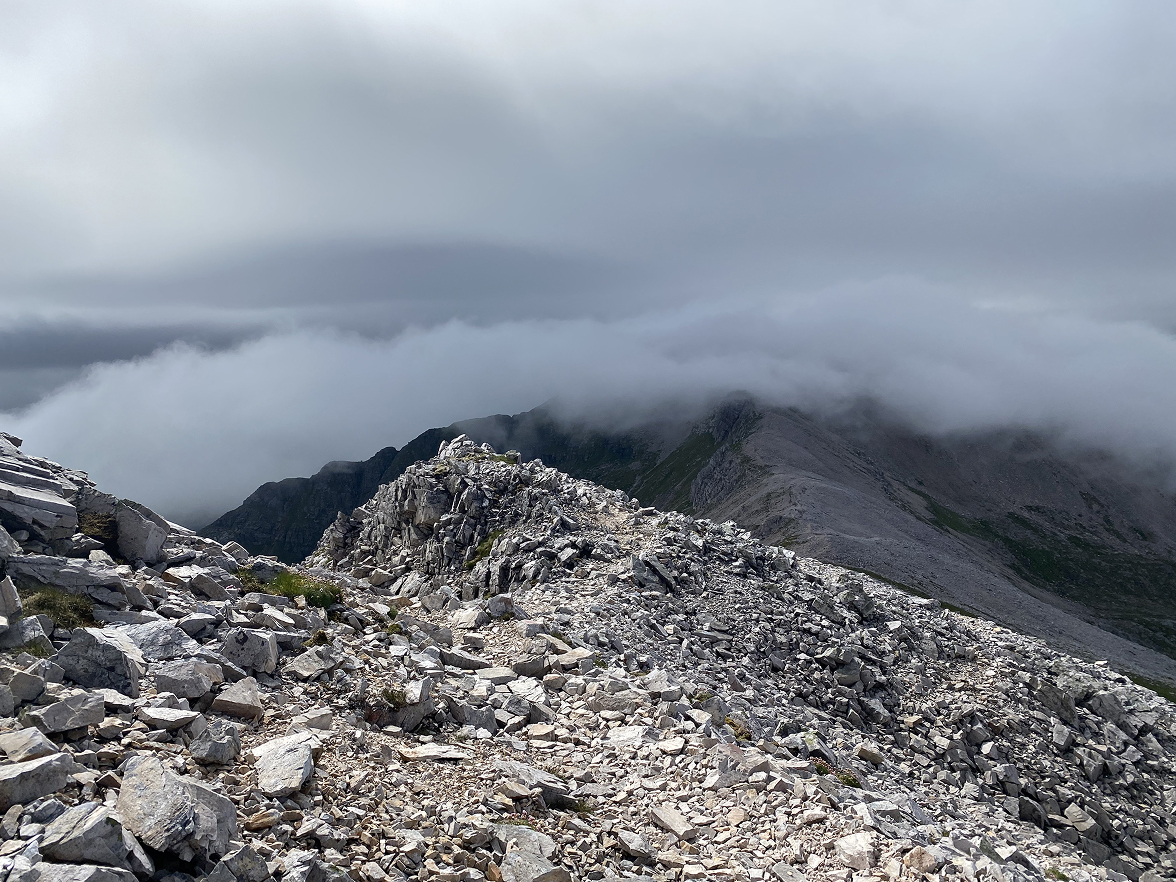
Dark woodland in evening light
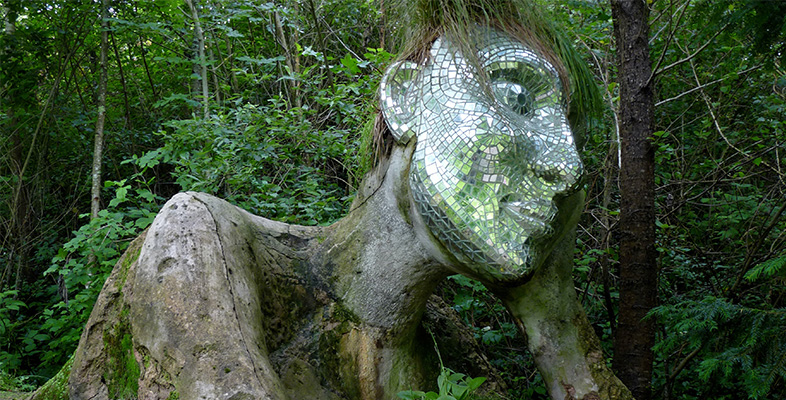
Unfurling fern frond

We're a community of researchers, practitioners, and thinkers committed to disseminating climate psychology widely, not just within our own professional circles. Through our flagship journal Explorations in Climate Psychology, our podcasts and talks, our library, and the contributions of members from across the world, we work to build a shared understanding of how psychology can meet this moment.

Explorations in Climate Psychology - the CPA journal

Navigating the inner and external work (relational and socio-political) that this moment calls on us to do, Explorations in Climate Psychology is CPA's flagship journal, published annually. We aim to be inclusive of the different ways people experience and engage with the climate and ecological crisis and welcome a wide range of forms: peer-reviewed research, analytical articles, reviews, interviews, reflections, testimonies, poetry, art, and lightly edited conversations.

Edited by CPA's Explorations Group, the journal explores current and emerging themes in the field, from climate grief and trauma to colonialism, decolonisation, the limits of Western rationality, and what it means to "stay with the trouble." The current editors of Explorations are noted in the latest issue.
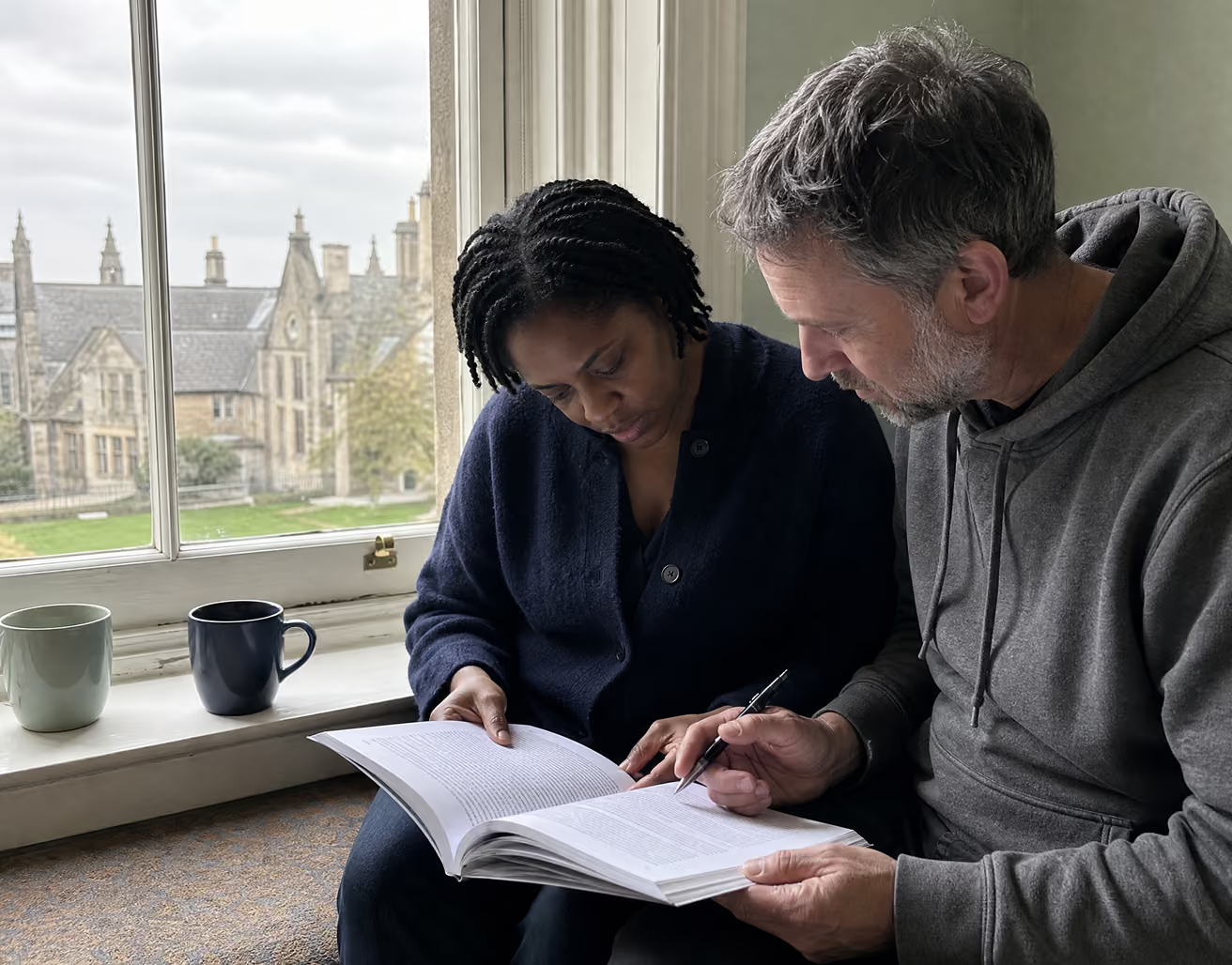

Two people reading an issue of the Explorations in Climate Psychology journal together
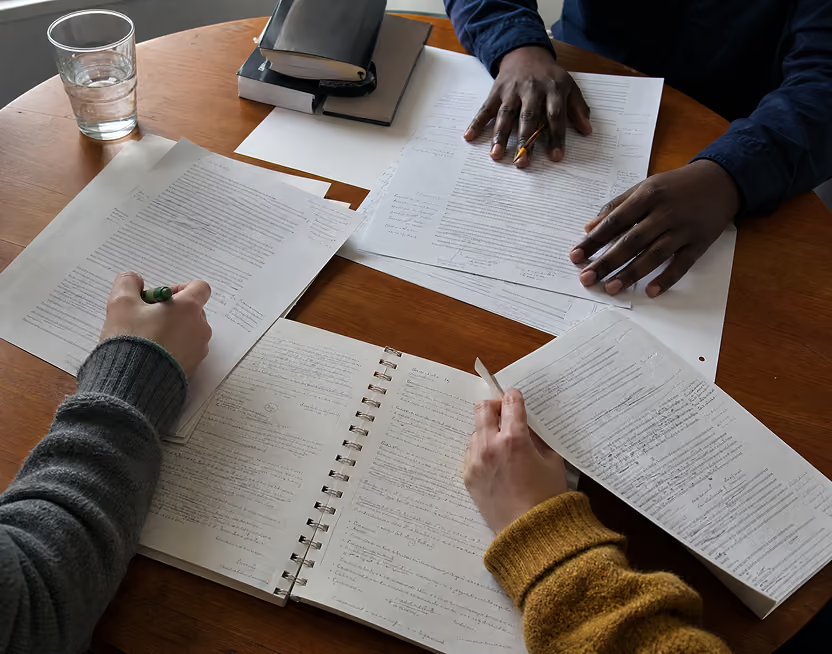
Three people researching together at a table with laptops and notes

We welcome contributions from inside and outside the CPA Community.

Find the latest call out here and guidelines for contributions here. The journal is open access and contributions can be used and quoted as long as they are referenced.

The Explorations group also offers online events with authors and other leading voices, which explore journal topics further.

See what's coming up

If you are interested in joining the editorial team (we particularly welcome young people and those of the Global Majority),  or wish to get in touch for another reason you can email them here.

A journal of climate psychology

Published regularly, featuring essays, research, and creative work from contributors across the UK and internationally. Each issue explores innovative forms of thinking and writing, navigating the relational and socio-political dimensions of the climate and ecological crisis.

Latest issue: Heavy weather: Exploring reactionary states of mind

Issue 8 is out now. In it you'll find explorations of the post-truth world, group narcissism, the unconscious, AI and power, and how these contribute to the reactionary state of mind.

Explorations: A journal of Climate Psychology

Published regularly, featuring essays, research, and creative work from contributors across the UK and internationally. Each issue explores innovative forms of thinking and writing, navigating the relational and socio-political dimensions of the climate and ecological crisis.

We also publish pieces from our journal via our Substack account. You can connect with us there, just follow @climatepsychologyexplorations on Substack.

New to Climate Psychology? Start here

Climate psychology is a young field with deep roots. If you're new to it, the resources below are good places to begin: foundational guides, podcasts and videos, defining texts, and the essential reading that practitioners and researchers return to again and again.

Hands resting on a book beside a mug and reading glasses
Three people in discussion around a coffee table

The Handbook of Climate Psychology

CPA's foundational guide to the field, freely available to download. The handbook introduces the key concepts, frameworks, and questions that shape climate psychology, and is used widely as an entry point for practitioners, researchers, and the curious.

Free Open University course

Introducing Climate Psychology: facing the climate crisis

The course explores ideas from social theory, psychoanalysis, ecopsychology, eco-feminism and post-humanism to gain a deeper understanding of the climate and ecological crisis, its impact on our wellbeing and how to build psychological resilience. The course is endorsed and supported by the CPA.

Climate Crisis Conversations

Our podcasts offers an accessible, conversational entry point into climate psychology, featuring CPA practitioners, researchers, and friends in dialogue about the climate and biodiversity crisis and the full range of emotional responses to it.

Can ancient myths help transform the narratives that led to the climate change crisis?

Climate Change: Finding the silver lining, part 1

Climate Change: Finding the silver lining, part 2

What our members are sharing

Climate psychology is built collaboratively, by members for members and beyond. The work below reflects what people across our community are thinking about, researching, writing, and making right now. These are member contributions, not CPA publications, voices from across the alliance.

CPA members sharing handwritten notes around a table
Thinking Space
Climate and ecological emotions
Climate justice & decolonising

Hosting and facilitating a Climate café listening circle (CCLC) training

Do you want to help build resilience in your community? Climate Cafe LIstening Circle (CCLC) Training builds the confidence, skills, and peer community to facilitate your own circles. Delivered as a structured programme over three sessions in closed cohorts, with ongoing supervision and support afterwards.

Wet garden path through lush greenery

The Climate Crisis Digest is our monthly publication, usually a short piece written by members.

The name Digest reflects the psychoanalyst Wilfred Bion's insight that experience needs to be digested in order to be thinkable, especially when it is hard to bear (hence CPA's approach to difficult truths). The Digest style is not academic or polemical, more journalistic and exploratory in tone. That requires reflection by the author, to invite reflection in readers. Reflection here means inquiring into our emotional experience so as to more fully engage with the meaning of what is written.

The Digest is edited by Thulsi Prabakaran.

Subscribe to our newsletter.

All news posts

Our library is a collection of open-access research and resources, written or recommended by CPA members.

Displaying
1
of
1
articles
Thank you! Your submission has been received!
Oops! Something went wrong while submitting the form.
Theory and frameworks
Denial & avoidance
Climate and ecological emotions

Climate Trauma: Towards a New Taxonomy of Traumatology

ABSTRACT: The disarmingly innocuous term 'climate change' expresses a psychosocial defense mechanism that prompts us to recoil when we consider the implications of climate science. When viewed honestly through the lens of traumatology, this deepening existential crisis presents an entirely new, unprecedented, and higher-order category of trauma: Climate Trauma. What is unique about this category of trauma is that it is an ever-present, ever-growing threat to the biosphere, one that calls into question our shared identity: what does it mean to be 'human' in the Anthropocene? Because it is superordinate, Climate Trauma is continually triggering all past traumas - personal, cultural, and intergenerational - and will continue to do so until such time as it is acknowledged.

2019
Research papers
Climate Trauma: Towards a New Taxonomy of Traumatology
Woodbury
2019
Therapeutic perspectives
Climate and ecological emotions

My climate journey: One cognitive behavioural psychotherapist's account

From The Cognitive Behaviour Therapist (Willsher & Freeston, 2024): Climate change distress is a challenge to people seeking help, and to those providing help. Those providing help are working in a new area of clinical practice where little is known, but they may also be experiencing climate change distress. The aim of this article is to highlight the personal and professional implications of the unfolding climate crisis and how we might better understand and support those with understandable, yet intense, emotional reactions to the climate crisis. The article consists of a first-person narrative by Claire Willsher, a CBT psychotherapist with lived experience of climate anxiety, and a commentary on the narrative based on the psychology of climate change literature by Mark Freeston.

n.d.
Research papers
My climate journey: One cognitive behavioural psychotherapist's account
Willsher
Youth & intergenerational
Therapeutic Support
Climate and ecological emotions

'There's no helpline'

ABSTRACT (Open access, PMC): Climate distress in young people is very likely to increase in coming years, and young people's mental health services need to be prepared to meet the demand. This paper reports a qualitative pilot study to establish the views of three stakeholder groups involved in youth mental health counselling services in England: young people, mental health counsellors, and strategic partners. They find broad agreement amongst youth mental health service users and providers that climate distress comprises a range of emotional responses to climate change, including anxiety, hopelessness, isolation, guilt and injustice, exacerbated by developmental, social and informational contexts. Service providers can support young people by surfacing, validating, and channelling these emotional responses, but they themselves need training and support to do this effectively.

2024
Research papers
Whitmarsh, L.
Poortinga, W.
Jenkins, C.
Constable, C.
There's no helpline'
Williams
2024
Therapeutic perspectives
Climate and ecological emotions

Acceptance and commitment therapy as an approach for working with climate distress

ABSTRACT (open access via Cardiff ORCA repository): Climate distress describes a complex array of emotional responses to climate change, which may include anxiety, despair, anger and grief. This paper presents a conceptual analysis of how acceptance and commitment therapy (ACT) is relevant to supporting those with climate distress. ACT aims to increase psychological flexibility, consisting of an open and aware orientation to one's experiences, and an engaged approach to living, guided by personal values. By embracing climate distress as a natural human experience and promoting value-guided action, ACT offers a promising approach that brings co-benefits to individuals and wider society.

2024
Research papers
Acceptance and commitment therapy as an approach for working with climate distress
Williams
2024
Climate justice & decolonising
Theory and frameworks

Indigenous Climate Change Studies: Indigenizing Futures, Decolonizing the Anthropocene

Whyte names and maps an emerging field he provisionally calls 'Indigenous climate change studies', encompassing the work of Indigenous and allied scholars, knowledge keepers, scientists and leaders supporting Indigenous peoples' capacities to address climate change. The essay surveys Indigenous climate resiliency plans, policy documents, declarations and academic scholarship, arguing that climate change cannot be understood as a purely 'natural' phenomenon but must be situated within processes of extraction, dispossession and settlement that Indigenous communities have long resisted and theorised. Whyte frames Indigenous futurity and decolonisation as central, rather than peripheral, to understanding and responding to the climate crisis, offering a foundational orientation for the wider field.

2017
Research papers
Kyle Whyte
Indigenous Climate Change Studies: Indigenizing Futures, Decolonizing the Anthropocene
Whyte
2017
Creative practice
Therapeutic Support
Climate and ecological emotions

Toward Multispecies Mourning: Imagining an Art Therapy for Ecological Grief

Art therapy, ecological grief, mourning and climate loss; explores creative practice as a pathway for ecological grieving.

2024
Research papers
Beatrice Wharldall
Toward Multispecies Mourning: Imagining an Art Therapy for Ecological Grief
Wharldall
2024
Theory and frameworks
Policy
Denial & avoidance

The Role of Subjective Factors in Local Authorities Action on Climate Change in South West England

From the PhD thesis abstract (Westcott, University of the West of England, 2016): This study examines the question of whether subjective attitudes to climate change play a significant part in the determination of local authorities' policy and actions on climate change mitigation; whether the personal views of council members and officers about climate change, their beliefs, fears and attitudes affect the outcomes in terms of policy and action, or whether organizational culture, norms and collectively policed limits to discourse have this effect; or whether the influence of central government policy is so overwhelming that action and policy is determined almost wholly by external and objective influences. Interviews with officers and members of local authorities in the South West of England identify that considerable reductions in council carbon emissions are possible when subjective factors align with organisational will.

2016
Research papers
The Role of Subjective Factors in Local Authorities Action on Climate Change in South West England
Westcott
2016
Youth & intergenerational
Climate and ecological emotions
Therapeutic Support

Voice 7: Climate Anxiety Has Taught Me This, So Far...

A young person reflects on a counselling session where their climate anxiety was addressed in an unexpected way, prompting a rethink of assumptions about how society understands climate anxiety.

2024
Books & chapters
Voice 7: Climate Anxiety Has Taught Me This, So Far...
Walshe
2024
Therapeutic perspectives
Climate and ecological emotions

A Narrative Exploration of how Clinical Psychologists deal with the Climate and Ecological Emergency

ABSTRACT (Open access): The discipline of clinical psychology is waking up to the climate crisis. There is growing consensus that the mental and physical health impacts of climate and ecological change will be significant, and will compound existing health and social inequalities. Whilst many UK clinical psychologists recognise climate change as professionally relevant, there is no literature documenting their level of awareness about the threats of climate change to psychological wellbeing. Interviews were conducted with 13 clinical psychologists working in the NHS; narrative analysis revealed identity dilemmas and social narratives about the profession influencing whether and how clinical psychologists adopted a climate-concerned position in their professional lives.

n.d.
Research papers
A Narrative Exploration of how Clinical Psychologists deal with the Climate and Ecological Emergency
Walker

Join our community of thinkers, researchers, and reflective practitioners

CPA is more than a publisher or a library. We're a working community of people thinking together about climate psychology. Our members participate in regular Thinking Spaces, contribute to research groups, edit the Explorations in Climate Psychology Journal, maintain the library, and bring their own work into shared conversation. Research at CPA is collaborative, generative, and grounded in practice.

Why join:

  • Monthly Thinking Space

  • Research Group

  • Opportunities to Publish

  • Intergenerational buddying

  • Student and Young Members Group

  • Opportunities to Publish

House with lit windows under a sunset sky