

Research and resources, shaped by those doing the work

Dark woodland in evening light
Unfurling fern frond

We're a community of researchers, practitioners, and thinkers committed to disseminating climate psychology widely, not just within our own professional circles. Through our flagship journal Explorations in Climate Psychology, our podcasts and talks, our library, and the contributions of members from across the world, we work to build a shared understanding of how psychology can meet this moment.

Explorations in Climate Psychology - the CPA journal

Navigating the inner and external work (relational and socio-political) that this moment calls on us to do, Explorations in Climate Psychology is CPA's flagship journal, published annually. We aim to be inclusive of the different ways people experience and engage with the climate and ecological crisis and welcome a wide range of forms: peer-reviewed research, analytical articles, reviews, interviews, reflections, testimonies, poetry, art, and lightly edited conversations.

Edited by CPA's Explorations Group, the journal explores current and emerging themes in the field, from climate grief and trauma to colonialism, decolonisation, the limits of Western rationality, and what it means to "stay with the trouble." The current editors of Explorations are noted in the latest issue.
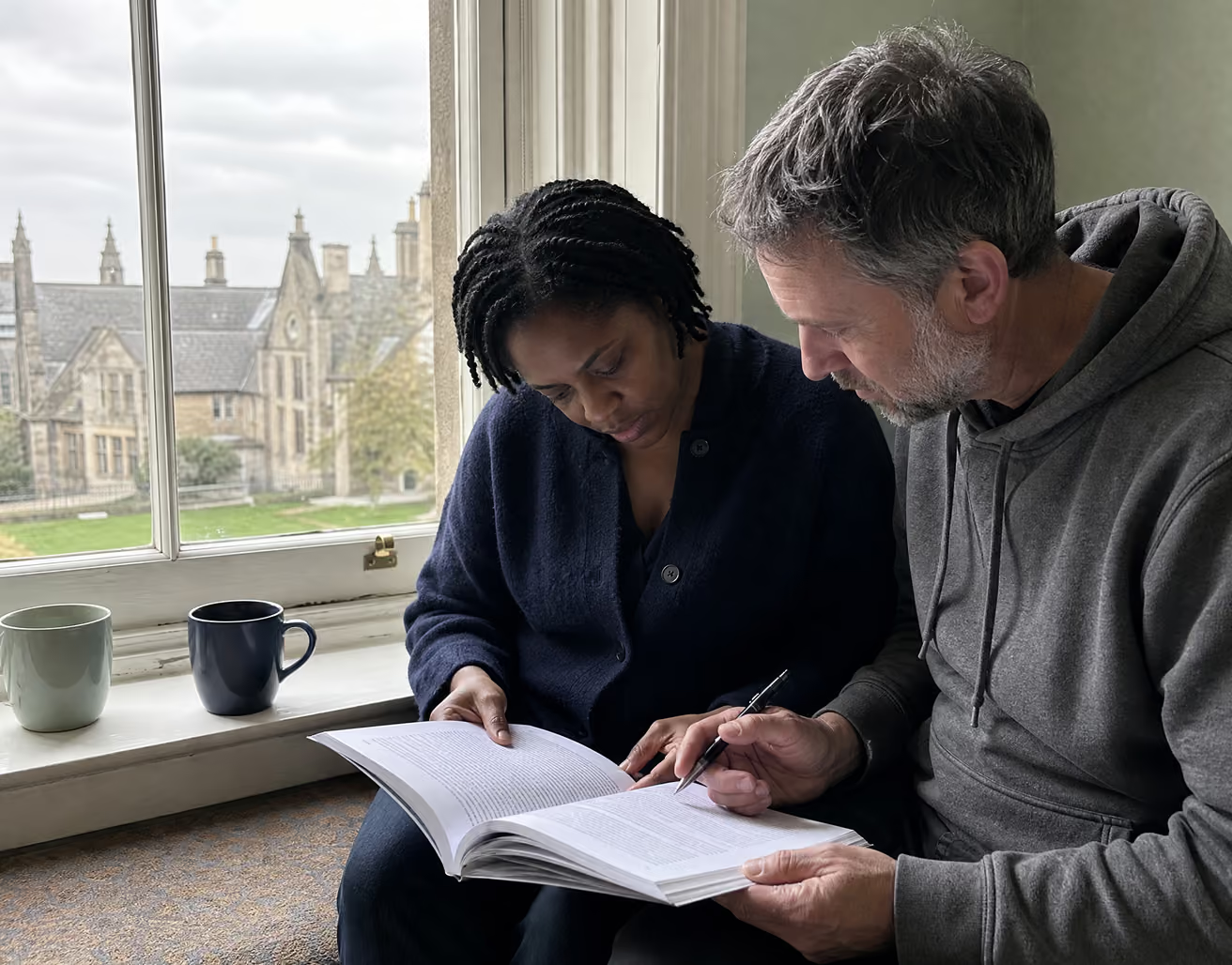

Two people reading an issue of the Explorations in Climate Psychology journal together
Three people researching together at a table with laptops and notes

We welcome contributions from inside and outside the CPA Community.

Find the latest call out here and guidelines for contributions here. The journal is open access and contributions can be used and quoted as long as they are referenced.

The Explorations group also offers online events with authors and other leading voices, which explore journal topics further.

See what's coming up

If you are interested in joining the editorial team (we particularly welcome young people and those of the Global Majority),  or wish to get in touch for another reason you can email them here.

A journal of climate psychology

Published regularly, featuring essays, research, and creative work from contributors across the UK and internationally. Each issue explores innovative forms of thinking and writing, navigating the relational and socio-political dimensions of the climate and ecological crisis.

Latest issue: Heavy weather: Exploring reactionary states of mind

Issue 8 is out now. In it you'll find explorations of the post-truth world, group narcissism, the unconscious, AI and power, and how these contribute to the reactionary state of mind.

Explorations: A journal of Climate Psychology

Published regularly, featuring essays, research, and creative work from contributors across the UK and internationally. Each issue explores innovative forms of thinking and writing, navigating the relational and socio-political dimensions of the climate and ecological crisis.

We also publish pieces from our journal via our Substack account. You can connect with us there, just follow @climatepsychologyexplorations on Substack.

New to Climate Psychology? Start here

Climate psychology is a young field with deep roots. If you're new to it, the resources below are good places to begin: foundational guides, podcasts and videos, defining texts, and the essential reading that practitioners and researchers return to again and again.

Hands resting on a book beside a mug and reading glasses
Three people in discussion around a coffee table

The Handbook of Climate Psychology

CPA's foundational guide to the field, freely available to download. The handbook introduces the key concepts, frameworks, and questions that shape climate psychology, and is used widely as an entry point for practitioners, researchers, and the curious.

Free Open University course

Introducing Climate Psychology: facing the climate crisis

The course explores ideas from social theory, psychoanalysis, ecopsychology, eco-feminism and post-humanism to gain a deeper understanding of the climate and ecological crisis, its impact on our wellbeing and how to build psychological resilience. The course is endorsed and supported by the CPA.

Climate Crisis Conversations

Our podcasts offers an accessible, conversational entry point into climate psychology, featuring CPA practitioners, researchers, and friends in dialogue about the climate and biodiversity crisis and the full range of emotional responses to it.

What is Climate Psychology? A way of listening...

Eco-anxiety, eco-despair, eco-depression, eco-grief? Or maybe eco-empathy?

What's under the surface of the attacks on school strikers?

What our members are sharing

Climate psychology is built collaboratively, by members for members and beyond. The work below reflects what people across our community are thinking about, researching, writing, and making right now. These are member contributions, not CPA publications, voices from across the alliance.

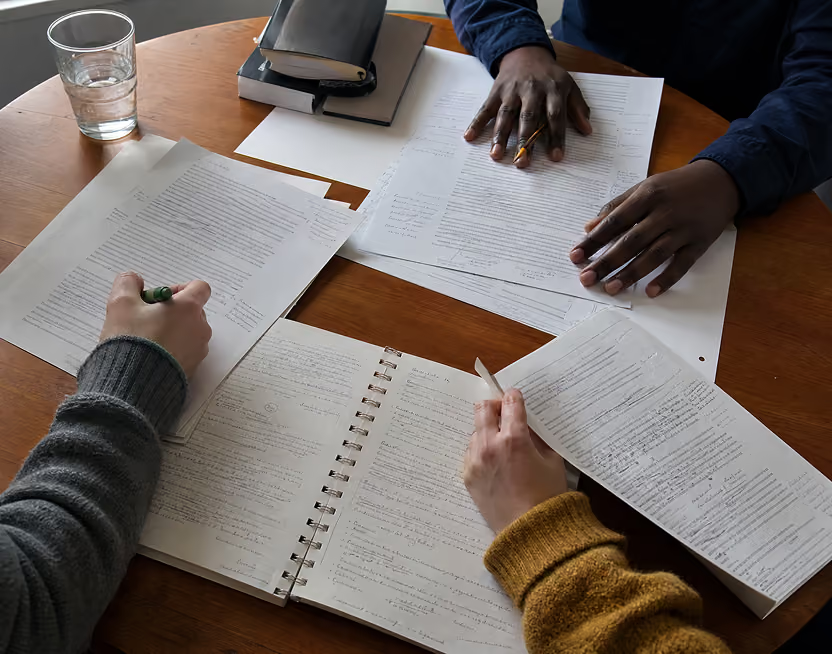
CPA members sharing handwritten notes around a table
Thinking Space
Climate and ecological emotions
Climate justice & decolonising

Hosting and facilitating a Climate café listening circle (CCLC) training

Do you want to help build resilience in your community? Climate Cafe LIstening Circle (CCLC) Training builds the confidence, skills, and peer community to facilitate your own circles. Delivered as a structured programme over three sessions in closed cohorts, with ongoing supervision and support afterwards.

Wet garden path through lush greenery

The Climate Crisis Digest is our monthly publication, usually a short piece written by members.

The name Digest reflects the psychoanalyst Wilfred Bion's insight that experience needs to be digested in order to be thinkable, especially when it is hard to bear (hence CPA's approach to difficult truths). The Digest style is not academic or polemical, more journalistic and exploratory in tone. That requires reflection by the author, to invite reflection in readers. Reflection here means inquiring into our emotional experience so as to more fully engage with the meaning of what is written.

The Digest is edited by Thulsi Prabakaran.

Subscribe to our newsletter.

All news posts

Our library is a collection of open-access research and resources, written or recommended by CPA members.

Displaying
1
of
1
articles
Thank you! Your submission has been received!
Oops! Something went wrong while submitting the form.
Therapeutic perspectives
Nature connection
Theory and frameworks

The Importance of Psychotherapy as an Eco-systemic Activity

From The Psychotherapist, Issue 40, Winter 2008-9, pp.31-33: Directly as a result of our influence, the ecosystems of the planet are becoming corrupted (in its original sense of rupture), broken down and disintegrated. It follows that the human psyche is the root origin, cause and catalyst of these changes. It is not so much the physical eco-systemic changes that are the 'problem', as usually presented - these are merely symptomatic of deeper causes rooted in the human unconscious, in unfulfilled desires and strivings, as expressed and acted out through everyday behaviour. These deeper dimensions of eco-systemic 'problems' have been neglected for decades by both the environmental movement and by psychotherapists.

2008
Research papers
The Importance of Psychotherapy as an Eco-systemic Activity
Maiteny
2008
Nature connection
Theory and frameworks
Therapeutic perspectives

Yearning for our Niche

From Journal of Holistic Healthcare (The Ecopsychology Issue): As human beings, we mostly use our capacities to invent ever more ingenious ways of satisfying desires through what can be called a 'consuming orientation'. We know that consuming is ultimately unsatisfying, but we persist as if there were no other route to well-being and mental health. The challenge for the human species in the 21st century is to have the will to live as part of a bigger context, of the bigger body of Earth of which we are members. Deeper, more mentally and emotionally sustainable meaningfulness and mental health can come more from seeking our true niche in the ecosystem than by trying to fill ourselves up by consuming it as a resource.

2009c
Research papers
Yearning for our Niche
Maiteny
2009
Theory and frameworks
Nature connection

On Links Between Meaning, Ecology and a Sustainable Future

One of the most pressing needs of our times is to understand better the mutually constitutive relationship between nature and culture. I take 'nature' (from the Latin for 'to be born') to encompass both the inorganic 'building blocks' of life and the bio-ecological processes - mediated by living organisms and their interrelations - that sustain life on earth. 'Culture' is the domain where meaning and value(s), including those relating to nature, are constructed and represented. Humans and their constructions - such as economics, politics, religions, science, technology - embody meanings and values and are, in turn, informed and changed by them.

1996
Research papers
On Links Between Meaning, Ecology and a Sustainable Future
Maiteny
1996
Climate justice & decolonising
Nature connection
Theory and frameworks

Perceptions of Nature by Indigenous Communities

From the Encyclopedia of Forest Science (Elsevier, 2004): The purpose of this article is to provide an overview of how indigenous communities perceive and relate to the bio-ecological contexts of which they are part and on which they depend. The main message is that there is much more to learn from them than information about plant resources, or methods to enhance western style conservation management. Forest is only one such context and it is possible to discern principles that also apply in others.

2004
Articles & reflections
Perceptions of Nature by Indigenous Communities
Maiteny
2004
Theory and frameworks
Nature connection
Policy

LinkingThinking: Linking everyday life into natural systems and resource use

From Linkingthinking: New perspectives on thinking and learning for sustainability (WWF Scotland, 2005, by Sterling, Maiteny, Irving and Salter): Although there is a strong argument for developing Linkingthinking ideas and skills in education, it is hardly yet recognised in current curricula and policy objectives. The writers, partners and WWF Scotland have developed this package in the belief that Linkingthinking is vital to help people cope with, understand and address the complex issues that increasingly dominate life, and is a perspective and skill that can be learnt and taught. The materials are designed to help develop the thinking skills - flexibility, resourcefulness, creativity, self-reliance and empathy - that citizens and professionals of tomorrow will require.

2005b
Research papers
LinkingThinking: Linking everyday life into natural systems and resource use
Maiteny
2005
Theory and frameworks
Nature connection
Hope & resilience

Longing to be Human: Evolving ourselves in healing the Earth

Working in ecological education and research since the late 1970s has often had a "Groundhog Day" quality about it - every few years, witnessing similar responses to peaks in anxiety about ecological breakdown. The particular psycho-spiritual dimensions of our species are the key to bringing ourselves out of this ecological breakdown, and provide vital signs that point to our role, as individuals and collective, in the planet's evolutionary future. The causes of our existential planetary crisis - ecological, social and personal mental health - are emotional and spiritual, rooted in our yearnings for meaningfulness in life and how we seek to satisfy them. Chapter 4 of 'Vital Signs: Psychological Responses to Ecological Crisis', ed. Mary-Jayne Rust & Nick Totton, Karnac, 2011.

2011
Books & chapters
Longing to be Human: Evolving ourselves in healing the Earth
Maiteny
2011
Therapeutic perspectives
Climate and ecological emotions
Hope & resilience

Eco-anxiety in the Therapy Room: Affect, Defences and Implications for Practice

Based on findings from the author's doctoral research about how the climate and ecological emergency (CEE) emerges in the therapy room, this chapter discusses revisioning therapy as a collective eco-psycho-social endeavour rather than a purely individualistic one. Implications for practice include the importance of holding hope, the need for therapists to process their own feelings, and being more proactive in responding to clients' cues, with the notion of a traumatised sensibility in relation to the CEE implied throughout.

2024
Books & chapters
Eco-anxiety in the Therapy Room: Affect, Defences and Implications for Practice
Macagnino
2024
Denial & avoidance
Hope & resilience
Theory and frameworks

The climate swerve

A substantial extract of this essential book is available on google books.

2017
Books & chapters
Robert Jay Lifton
The climate swerve
Lifton
2017
Therapeutic perspectives
Theory and frameworks
Activism & collective action

Robert Jay Lifton: interview on the witnessing professional (with David R. Kopacz)

In this 2021 interview with physician David R. Kopacz, Lifton unpacks the concept of the witnessing professional, which he developed alongside the idea of malignant normality: societal expectations that are deeply destructive yet rendered ordinary, legal and unquestioned. He argues that professionals retain the capacity to expose and resist malignant normality without abandoning their professional identity, and that doing so restores an ethical dimension to work that has become increasingly technicised and prone to psychic numbing. He traces this idea through his own history in the physicians' anti-nuclear movement, and connects it explicitly to the Daedalus special issue on witnessing professionals and climate change, in which his essay 'On Becoming Witnessing Professionals' appears. The conversation ranges into whether the capacity for ethical witnessing can be taught to medical trainees, the risks professionals face when speaking out, and Lifton's concept of an 'animating relationship' to death anxiety and guilt, in which suffering is transformed into a sense of responsibility rather than avoidance. He closes by linking this to his broader idea of the Protean Self - human beings' capacity for ongoing symbolic re-creation and change, which he sees as both vulnerable to totalist control and capable of resisting it.

2021
Articles & reflections
Robert Jay Lifton
Robert Jay Lifton: interview on the witnessing professional (with David R. Kopacz)
Lifton
2021

Join our community of thinkers, researchers, and reflective practitioners

CPA is more than a publisher or a library. We're a working community of people thinking together about climate psychology. Our members participate in regular Thinking Spaces, contribute to research groups, edit the Explorations in Climate Psychology Journal, maintain the library, and bring their own work into shared conversation. Research at CPA is collaborative, generative, and grounded in practice.

Why join:

  • Monthly Thinking Space

  • Research Group

  • Opportunities to Publish

  • Intergenerational buddying

  • Student and Young Members Group

  • Opportunities to Publish

House with lit windows under a sunset sky