

Research and resources, shaped by those doing the work

Dark woodland in evening light
Unfurling fern frond

We're a community of researchers, practitioners, and thinkers committed to disseminating climate psychology widely, not just within our own professional circles. Through our flagship journal Explorations in Climate Psychology, our podcasts and talks, our library, and the contributions of members from across the world, we work to build a shared understanding of how psychology can meet this moment.

Explorations in Climate Psychology - the CPA journal

Navigating the inner and external work (relational and socio-political) that this moment calls on us to do, Explorations in Climate Psychology is CPA's flagship journal, published annually. We aim to be inclusive of the different ways people experience and engage with the climate and ecological crisis and welcome a wide range of forms: peer-reviewed research, analytical articles, reviews, interviews, reflections, testimonies, poetry, art, and lightly edited conversations.

Edited by CPA's Explorations Group, the journal explores current and emerging themes in the field, from climate grief and trauma to colonialism, decolonisation, the limits of Western rationality, and what it means to "stay with the trouble." The current editors of Explorations are noted in the latest issue.


Two people reading an issue of the Explorations in Climate Psychology journal together
Three people researching together at a table with laptops and notes

We welcome contributions from inside and outside the CPA Community.

Find the latest call out here and guidelines for contributions here. The journal is open access and contributions can be used and quoted as long as they are referenced.

The Explorations group also offers online events with authors and other leading voices, which explore journal topics further.

See what's coming up

If you are interested in joining the editorial team (we particularly welcome young people and those of the Global Majority),  or wish to get in touch for another reason you can email them here.

A journal of climate psychology

Published regularly, featuring essays, research, and creative work from contributors across the UK and internationally. Each issue explores innovative forms of thinking and writing, navigating the relational and socio-political dimensions of the climate and ecological crisis.

Latest issue: Heavy weather: Exploring reactionary states of mind

Issue 8 is out now. In it you'll find explorations of the post-truth world, group narcissism, the unconscious, AI and power, and how these contribute to the reactionary state of mind.

Explorations: A journal of Climate Psychology

Published regularly, featuring essays, research, and creative work from contributors across the UK and internationally. Each issue explores innovative forms of thinking and writing, navigating the relational and socio-political dimensions of the climate and ecological crisis.

We also publish pieces from our journal via our Substack account. You can connect with us there, just follow @climatepsychologyexplorations on Substack.

New to Climate Psychology? Start here

Climate psychology is a young field with deep roots. If you're new to it, the resources below are good places to begin: foundational guides, podcasts and videos, defining texts, and the essential reading that practitioners and researchers return to again and again.

Hands resting on a book beside a mug and reading glasses
Three people in discussion around a coffee table

The Handbook of Climate Psychology

CPA's foundational guide to the field, freely available to download. The handbook introduces the key concepts, frameworks, and questions that shape climate psychology, and is used widely as an entry point for practitioners, researchers, and the curious.

Free Open University course

Introducing Climate Psychology: facing the climate crisis

The course explores ideas from social theory, psychoanalysis, ecopsychology, eco-feminism and post-humanism to gain a deeper understanding of the climate and ecological crisis, its impact on our wellbeing and how to build psychological resilience. The course is endorsed and supported by the CPA.

Climate Crisis Conversations

Our podcasts offers an accessible, conversational entry point into climate psychology, featuring CPA practitioners, researchers, and friends in dialogue about the climate and biodiversity crisis and the full range of emotional responses to it.

From Anxiety to Agency: stepping up, rather than shutting down, in the face of the climate change crisis

Rebellion is for Life, not just Extinction; focussing on regenerative culture

What our members are sharing

Climate psychology is built collaboratively, by members for members and beyond. The work below reflects what people across our community are thinking about, researching, writing, and making right now. These are member contributions, not CPA publications, voices from across the alliance.

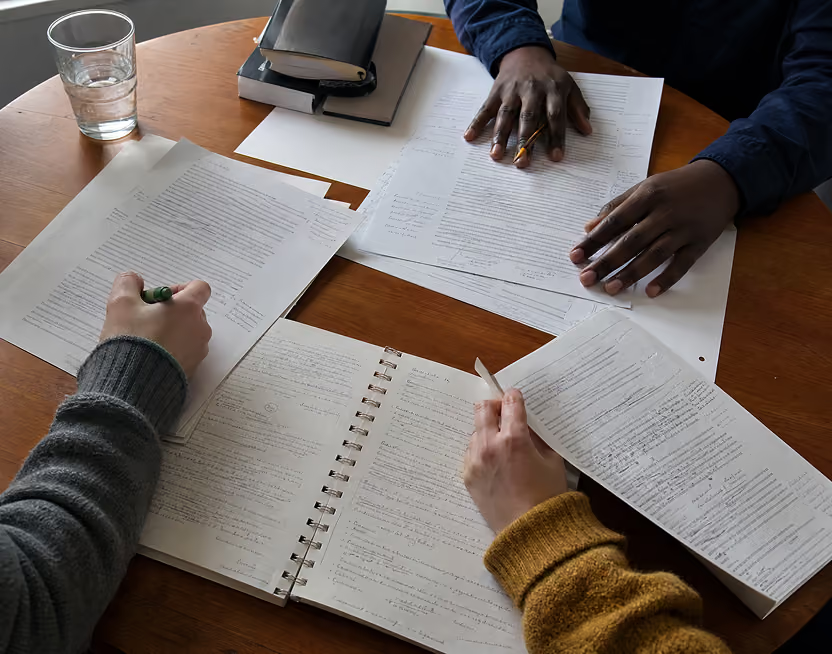
CPA members sharing handwritten notes around a table
Thinking Space
Climate and ecological emotions
Climate justice & decolonising

Hosting and facilitating a Climate café listening circle (CCLC) training

Do you want to help build resilience in your community? Climate Cafe LIstening Circle (CCLC) Training builds the confidence, skills, and peer community to facilitate your own circles. Delivered as a structured programme over three sessions in closed cohorts, with ongoing supervision and support afterwards.

Wet garden path through lush greenery

The Climate Crisis Digest is our monthly publication, usually a short piece written by members.

The name Digest reflects the psychoanalyst Wilfred Bion's insight that experience needs to be digested in order to be thinkable, especially when it is hard to bear (hence CPA's approach to difficult truths). The Digest style is not academic or polemical, more journalistic and exploratory in tone. That requires reflection by the author, to invite reflection in readers. Reflection here means inquiring into our emotional experience so as to more fully engage with the meaning of what is written.

The Digest is edited by Thulsi Prabakaran.

Subscribe to our newsletter.

All news posts

Our library is a collection of open-access research and resources, written or recommended by CPA members.

Displaying
1
of
1
articles
Thank you! Your submission has been received!
Oops! Something went wrong while submitting the form.
Climate and ecological emotions
Theory and frameworks

The Process of Eco-Anxiety and Ecological Grief: A Narrative Review and a New Proposal

ABSTRACT (CC BY 4.0): As the ecological crisis grows more intense, people experience many forms of eco-anxiety and ecological grief. This article explores the broad process of encountering eco-anxiety and ecological grief, and engages in the constructive task of building a new model of that process. Eco-anxiety and grief are here seen as fundamentally healthy reactions to threats and loss, and only the strongest forms of them are seen as problems. The aim is to help researchers, various professionals and the general public by providing a model which is simple enough but more nuanced than stage models which may give a false impression of linearity. The proposed new model includes both chronological and thematic aspects, with early phases of Unknowing and Semi-consciousness potentially followed by Awakening and various kinds of Shock and possible trauma.

2023
Research papers
The Process of Eco-Anxiety and Ecological Grief: A Narrative Review and a New Proposal
Pihkala
2023
Climate and ecological emotions
Theory and frameworks
Nature connection

How to Mourn for Animals? From Misanthropic Melancholia to Animal Ethical Mourning

ABSTRACT: The paper explores 'animal ethical mourning' through three directions: 1) mourning for nonhuman animals, 2) mourning for lost human ideals, and 3) mourning with nonhuman animals. First, it investigates the political and moral significance of animal ethical mourning, arguing it is a radical normative act. Second, it claims such mourning extends also to given human ideals, which our treatment of animals reveals to be forsaken; here it introduces 'misanthropic melancholia' as one affectively challenging yet normatively illuminating aspect of animal ethical mourning. Finally, it considers what it means to mourn with other animals. The paper's central claim is that more rituals and rhetoric are needed to evoke these aspects of animal ethical mourning.

2025
Research papers
How to Mourn for Animals? From Misanthropic Melancholia to Animal Ethical Mourning
Pihkala
2025
Climate and ecological emotions
Therapeutic perspectives

Climate Sorrow: Discerning Various Forms of Climate Grief and Responding to Them as a Therapist

Based on interdisciplinary research and workshop experience, this chapter offers tools for evaluating and working with various aspects of climate grief, which can manifest as both acute grief and a persistent mood. It discusses the challenge of discerning between normal but deep forms of climate grief and those requiring clinical attention, the interconnection of climate guilt and grief, and engages with Robert Neimeyer's framework of 'meaning reconstruction' and narrative re-storying.

2024
Books & chapters
Climate Sorrow: Discerning Various Forms of Climate Grief and Responding to Them as a Therapist
Pihkala
2024
Climate justice & decolonising
Climate and ecological emotions

Cut from 'country': the impact of climate change on the mental health of Aboriginal pastoralists

This study examines the mental health impacts of climate change on Aboriginal pastoralists in regional Australia, focusing on the social and psychological consequences of the downsizing of the pastoralism sector during a period of prolonged drought. Drawing on qualitative research, the authors document declining mental wellbeing among Aboriginal people who have been displaced from pastoral work and forced to migrate from regional areas into nearby towns, often through no fault of their own. The study explores the loss of connection to country and cultural identity bound up with this displacement, and highlights the need for alternative meaningful activities and support structures to help affected communities maintain a sense of wellbeing and purpose in the aftermath of livelihood loss driven by climate-related economic decline.

2015
Research papers
Pearce, M.
Eagle, L.
Low, D.
Schurmann, A.
Cut from 'country': the impact of climate change on the mental health of Aboriginal pastoralists
Pearce
2015
Denial & avoidance
Policy
Theory and frameworks

Socially Constructed Silence? Protecting Policymakers from the Unthinkable

Drawing on interviews with leading UK climate scientists and communicators, the authors argue that the climate science community's continued attachment to an idealised picture of value-free scientific rationality produces a 'socially constructed silence' - protecting researchers at an unconscious level from the emotional turbulence aroused by the politicisation of climate change, but leaving policymakers poorly served by open conversation about the science.

2016
Articles & reflections
Rosemary Randall
Socially Constructed Silence? Protecting Policymakers from the Unthinkable
Hoggett
2016
Activism & collective action
Hope & resilience
Climate and ecological emotions

Sustainable Activism: Managing Hope and Despair in Social Movements

Drawing on interviews with UK direct-action climate activists, the authors explore how activists manage the powerful feelings aroused by confronting the disturbing truth of climate change, identifying unhelpful binaries ('all or nothing', 'now or never') that can lead to despair, and describing a more emotionally-intelligent culture of proportionate engagement, self-care and reflection emerging among a newer generation of activists.

2016
Articles & reflections
Rosemary Randall
Sustainable Activism: Managing Hope and Despair in Social Movements
Hoggett
2016
Denial & avoidance
Climate and ecological emotions
Therapeutic perspectives

Getting Real (New Associations, Issue 29: Climate Change Special Issue, Article 1)

Written for the British Psychoanalytic Council's climate change special issue, exploring what it means to face the reality of the climate and ecological emergency without collapsing into denial or unrealistic optimism.

2019
Articles & reflections
Getting Real (New Associations, Issue 29: Climate Change Special Issue, Article 1)
2019
Climate and ecological emotions

A Guide to Climate Emotions

A guide to supporting reflection on climate emotions based on the research of Panu Pihkala and colleagues, including his taxonomy of climate emotions.

Tools & guides
A Guide to Climate Emotions
Pihkala
Climate and ecological emotions
Policy

Eco-Anxiety in Finland: A Tale of a National Awakening

Describes how, over 18 months, Finland - a small nation where the term for 'eco-anxiety' was barely used before 2017 - underwent a national reckoning with environmental anxiety, with peer support groups forming, educators training to encounter these feelings, and a national project developing skills in the social and health sector to help alleviate eco-anxiety, alongside intensifying social conflict.

2019
Articles & reflections
Eco-Anxiety in Finland: A Tale of a National Awakening
Pihkala
2019

Join our community of thinkers, researchers, and reflective practitioners

CPA is more than a publisher or a library. We're a working community of people thinking together about climate psychology. Our members participate in regular Thinking Spaces, contribute to research groups, edit the Explorations in Climate Psychology Journal, maintain the library, and bring their own work into shared conversation. Research at CPA is collaborative, generative, and grounded in practice.

Why join:

  • Monthly Thinking Space

  • Research Group

  • Opportunities to Publish

  • Intergenerational buddying

  • Student and Young Members Group

  • Opportunities to Publish

House with lit windows under a sunset sky