

Research and resources, shaped by those doing the work

Dark woodland in evening light
Unfurling fern frond

We're a community of researchers, practitioners, and thinkers committed to disseminating climate psychology widely, not just within our own professional circles. Through our flagship journal Explorations in Climate Psychology, our podcasts and talks, our library, and the contributions of members from across the world, we work to build a shared understanding of how psychology can meet this moment.

Explorations in Climate Psychology - the CPA journal

Navigating the inner and external work (relational and socio-political) that this moment calls on us to do, Explorations in Climate Psychology is CPA's flagship journal, published annually. We aim to be inclusive of the different ways people experience and engage with the climate and ecological crisis and welcome a wide range of forms: peer-reviewed research, analytical articles, reviews, interviews, reflections, testimonies, poetry, art, and lightly edited conversations.

Edited by CPA's Explorations Group, the journal explores current and emerging themes in the field, from climate grief and trauma to colonialism, decolonisation, the limits of Western rationality, and what it means to "stay with the trouble." The current editors of Explorations are noted in the latest issue.
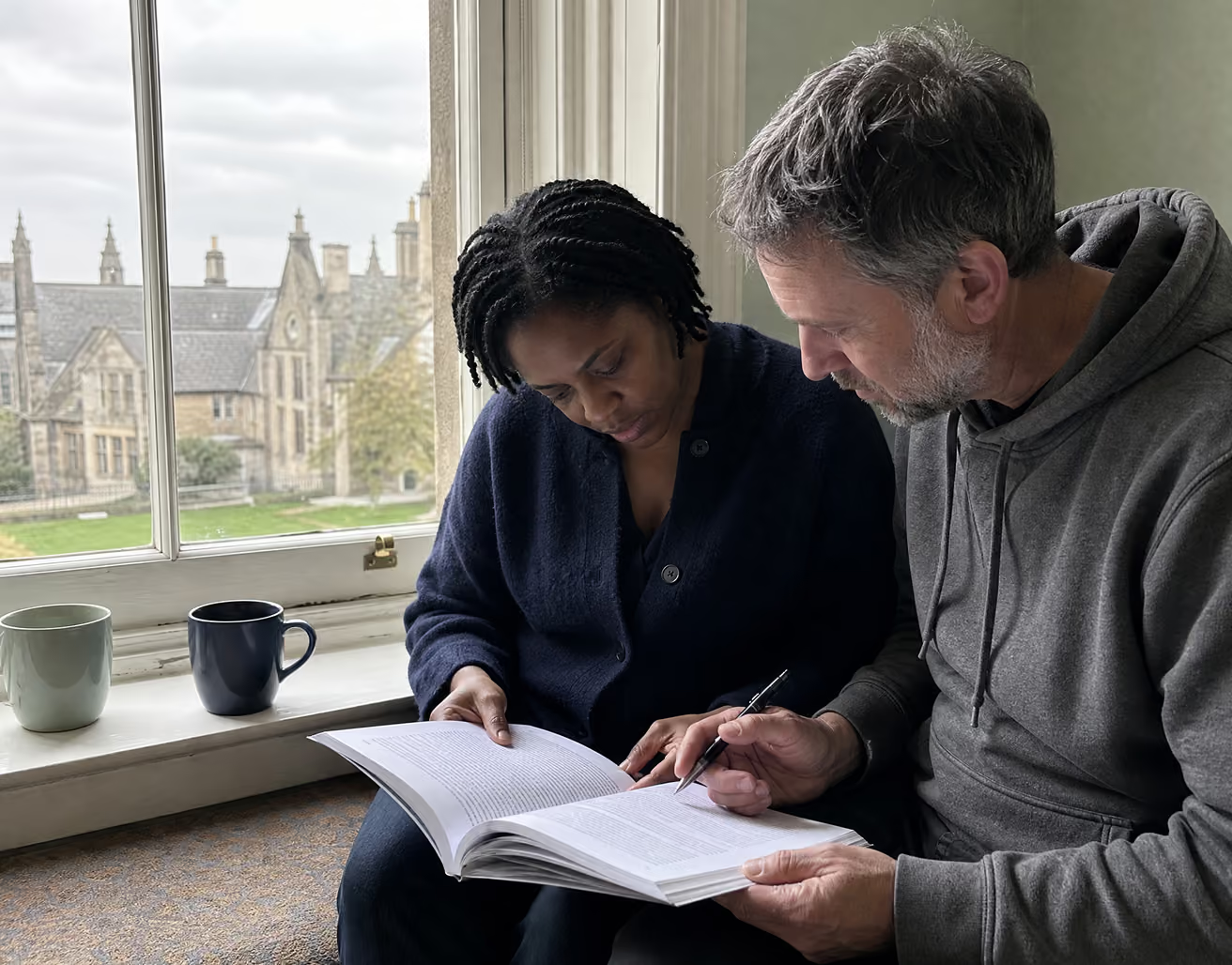

Two people reading an issue of the Explorations in Climate Psychology journal together
Three people researching together at a table with laptops and notes

We welcome contributions from inside and outside the CPA Community.

Find the latest call out here and guidelines for contributions here. The journal is open access and contributions can be used and quoted as long as they are referenced.

The Explorations group also offers online events with authors and other leading voices, which explore journal topics further.

See what's coming up

If you are interested in joining the editorial team (we particularly welcome young people and those of the Global Majority),  or wish to get in touch for another reason you can email them here.

A journal of climate psychology

Published regularly, featuring essays, research, and creative work from contributors across the UK and internationally. Each issue explores innovative forms of thinking and writing, navigating the relational and socio-political dimensions of the climate and ecological crisis.

Latest issue: Heavy weather: Exploring reactionary states of mind

Issue 8 is out now. In it you'll find explorations of the post-truth world, group narcissism, the unconscious, AI and power, and how these contribute to the reactionary state of mind.

Explorations: A journal of Climate Psychology

Published regularly, featuring essays, research, and creative work from contributors across the UK and internationally. Each issue explores innovative forms of thinking and writing, navigating the relational and socio-political dimensions of the climate and ecological crisis.

We also publish pieces from our journal via our Substack account. You can connect with us there, just follow @climatepsychologyexplorations on Substack.

New to Climate Psychology? Start here

Climate psychology is a young field with deep roots. If you're new to it, the resources below are good places to begin: foundational guides, podcasts and videos, defining texts, and the essential reading that practitioners and researchers return to again and again.

Hands resting on a book beside a mug and reading glasses
Three people in discussion around a coffee table

The Handbook of Climate Psychology

CPA's foundational guide to the field, freely available to download. The handbook introduces the key concepts, frameworks, and questions that shape climate psychology, and is used widely as an entry point for practitioners, researchers, and the curious.

Free Open University course

Introducing Climate Psychology: facing the climate crisis

The course explores ideas from social theory, psychoanalysis, ecopsychology, eco-feminism and post-humanism to gain a deeper understanding of the climate and ecological crisis, its impact on our wellbeing and how to build psychological resilience. The course is endorsed and supported by the CPA.

Climate Crisis Conversations

Our podcasts offers an accessible, conversational entry point into climate psychology, featuring CPA practitioners, researchers, and friends in dialogue about the climate and biodiversity crisis and the full range of emotional responses to it.

Motherhood and the Climate Crisis

Dr Renée Lertzman on being an earthling, the climate crisis and falling in love

Did we Care When Birds and Animals Died during the Sixth Extinction?

What our members are sharing

Climate psychology is built collaboratively, by members for members and beyond. The work below reflects what people across our community are thinking about, researching, writing, and making right now. These are member contributions, not CPA publications, voices from across the alliance.

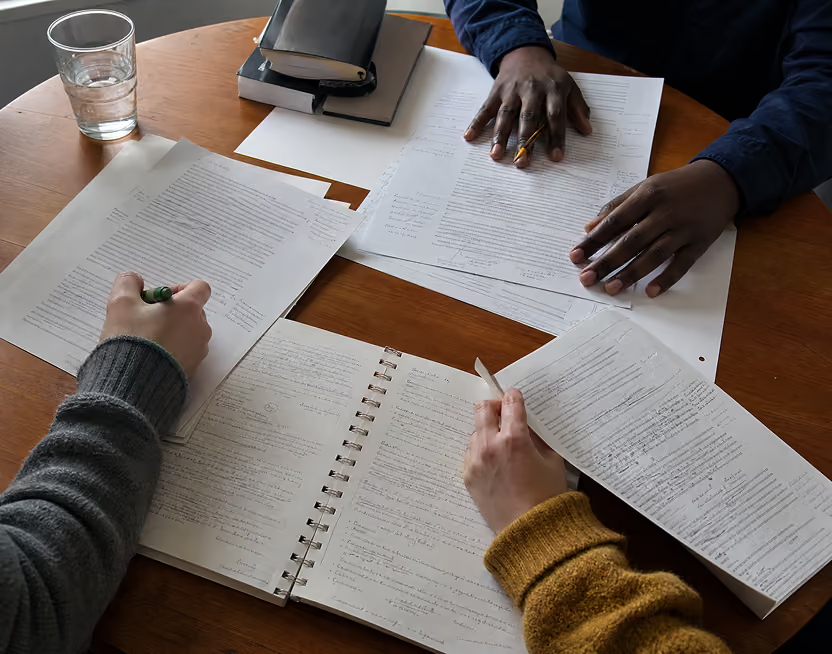
CPA members sharing handwritten notes around a table
Thinking Space
Climate and ecological emotions
Climate justice & decolonising

Hosting and facilitating a Climate café listening circle (CCLC) training

Do you want to help build resilience in your community? Climate Cafe LIstening Circle (CCLC) Training builds the confidence, skills, and peer community to facilitate your own circles. Delivered as a structured programme over three sessions in closed cohorts, with ongoing supervision and support afterwards.

Wet garden path through lush greenery

The Climate Crisis Digest is our monthly publication, usually a short piece written by members.

The name Digest reflects the psychoanalyst Wilfred Bion's insight that experience needs to be digested in order to be thinkable, especially when it is hard to bear (hence CPA's approach to difficult truths). The Digest style is not academic or polemical, more journalistic and exploratory in tone. That requires reflection by the author, to invite reflection in readers. Reflection here means inquiring into our emotional experience so as to more fully engage with the meaning of what is written.

The Digest is edited by Thulsi Prabakaran.

Subscribe to our newsletter.

All news posts

Our library is a collection of open-access research and resources, written or recommended by CPA members.

Displaying
1
of
1
articles
Thank you! Your submission has been received!
Oops! Something went wrong while submitting the form.
Climate and ecological emotions
Theory and frameworks

On the nature of eco-anxiety

Drawing on habit theory, this paper investigates habitual worry about global warming as a form of 'eco-anxiety', asking whether such worrying is constructive - a motivated pro-environmental response - or unconstructive, functioning more like a symptom of pathological worry. Across three studies, the authors find that global warming worry, when controlled for other worry sources such as personal issues and the economy, is not significantly associated with pathological worry, and instead correlates with markers of constructiveness including a 'green' self-identity and other determinants of pro-environmental behaviour. The habitual quality of the worry - its enduring, repetitive, automatic nature - is argued to be what gives it power to shape behaviour, whether toward constructive engagement or, potentially, toward paralysis, offering an empirically grounded case for taking eco-anxiety seriously as a largely adaptive rather than purely pathological response.

2020
Research papers
Bas Verplanken
Alexandru I Dobromir
On the nature of eco-anxiety
Verplanken
2020
Hope & resilience
Activism & collective action
Theory and frameworks

Why Acting Environmentally-Friendly Feels Good

ABSTRACT (CC BY 4.0): Recent research suggests that engagement in environmentally-friendly behavior can feel good. Current explanations for such a link do not focus on the nature of environmentally-friendly behavior itself, but rather propose well-being is more or less a side-benefit. We propose that the moral nature of environmentally-friendly behavior itself may elicit positive emotions as well, because engaging in this behavior can signal one is an environmentally-friendly and thus a good person. Our results show that engagement in environmentally-friendly behavior can indeed affect how people see themselves, and the more environmentally-friendly and positive people saw themselves, the better they felt about acting environmentally-friendly.

2016
Research papers
Why Acting Environmentally-Friendly Feels Good
Venhoeven
2016
Activism & collective action
Theory and frameworks
Hope & resilience

Why going green feels good

This study investigates why people report that acting sustainably feels good, despite such actions often requiring more effort or inconvenience than less sustainable alternatives. Testing whether the positive emotions associated with sustainable behaviour depend on how voluntary the action feels, the authors find that people report feeling more positive about sustainable actions when they have personally chosen to engage in them, and more negative about unsustainable actions chosen freely - suggesting that a sense of personal agency, rather than the environmental outcome alone, contributes to the positive emotional experience of green behaviour.

2020
Research papers
Why going green feels good
Venhoeven
2020
Climate justice & decolonising
Hope & resilience
Activism & collective action

Seeing more clearly

ABSTRACT: This study explored how a process of community transformation emerged in post-hurricane Puerto Rico. Most post-disaster research focuses on community and personal losses while little is known about strengths and positive outcomes. In the aftermath of Hurricanes Irma and Maria in 2017, vast structural injustices in Puerto Rico were made visible. In this grounded theory study, residents from different communities in Puerto Rico (N=69) shared their post-disaster experiences. Results revealed a phase-based theoretical model of post-disaster community transformation, with facilitators including a sense of community, posttraumatic growth, and critical consciousness, and barriers including leader burnout and interpersonal tensions.

2020
Research papers
Seeing more clearly
Unanue
2020
Parenting
Climate and ecological emotions
Creative practice

Rehearsing Radical Care: Motherhood in a Climate Crisis

For a growing number of people in the UK climate change is an important consideration when deciding whether to have a child. Motherhood in a Climate Crisis is a collaborative theatre-making project, held within structures of radical care, to create a brave space where women with diverse choices and experiences relating to motherhood could share their thoughts, feelings and concerns in safety and support. Outcomes of the project are described and implications for the issue in the consulting room are developed, alongside how an ethics of care is essential to imagining and building just futures.

2024
Books & chapters
Rehearsing Radical Care: Motherhood in a Climate Crisis
Turley
2024
Policy
Theory and frameworks
Youth & intergenerational
Creative practice

'Another Haiti starting from the youth'

ABSTRACT: Despite being on the front lines of climate catastrophe, the voices and actions of critically affected groups are often overlooked. The present research partnered with Haitian youth - who are marginalized from climate decision-making on the basis of nationality and age - to explore and address sustainability challenges in their coastal community. This study explored processes of individual and collective empowerment made possible through a community-based arts center course that integrated the arts and sciences to position youth as change agents for a more sustainable Haiti.

2020
Research papers
Another Haiti starting from the youth'
Trott
2020
Therapeutic perspectives
Nature connection
Theory and frameworks

Rewilding Therapy

This chapter suggests that in order to respond to our ecological crisis and offer clients a way to do the same, therapy needs to change; but also, many features of an ecosystemic therapy are already present within the field, often unrecognised as such. It explores how the inherent wildness of psychotherapy can be brought out, and what the implications are for practice.

2024
Books & chapters
Rewilding Therapy
Totton
2024
Therapeutic perspectives
Nature connection
Theory and frameworks

Living On Earth: Embodiment and Ecopsychology

Originally delivered as a talk and published in Self and Society (2007), Totton argues that psychotherapy - and body psychotherapy in particular - is already implicitly engaged in the project ecopsychology names explicitly: finding a good, embodied way for humans to live on earth. He sets out three strands of ecopsychology (the therapeutic effect of contact with the nonhuman world, practical work to shift human-nonhuman relations, and the philosophy of that relationship), then develops the idea of 'wild mind' - spontaneous, co-creative, self-balancing and inherently wise - as a counterpart to physical wild ecosystems. Drawing on Reichian body psychotherapy, Taoist philosophy, Bateson's systems thinking, and examples from indigenous land management (notably Kayapo agroforestry), Totton traces how Western culture's mind-body and culture-nature splits produce a fear of spontaneity rooted in early experiences such as toilet training, and how this fear underlies both personal alienation and ecological destruction. He proposes that therapy's task is to act as guardian and cultivator of this 'wild mind,' relaxing the defended, controlling ego enough for embodied, relational wisdom to re-emerge - in the client, and by extension in how humans relate to the nonhuman world.

2007
Articles & reflections
Living On Earth: Embodiment and Ecopsychology
Totton
2007
Therapeutic perspectives
Nature connection
Theory and frameworks

Wild Therapy

Originally published in Therapy Today (March 2011) as a taster for his book Wild Therapy: Undomesticating Inner and Outer Worlds, Totton argues that ecopsychology and therapeutic practice have rarely been properly integrated, each tending to be bolted onto the other rather than fused into something new. He traces contemporary anxiety about control back to the Neolithic shift from hunter-gatherer to agricultural society, arguing that humans domesticated themselves as much as other species, producing deep-seated trauma, dissociation and denial that now obstructs collective engagement with ecological crisis. Central to the piece is his concept of Wild Mind - a state of spontaneous, self-organising awareness connected with the nonhuman world - which he proposes therapy is uniquely positioned to support and protect, alongside qualities such as interdependence, relationality, liminality and embodiment. Totton suggests that most people are already close to overwhelm, protecting a fragile bubble of personal stability against threatening information, and that therapists should name this overwhelm directly rather than compounding it, helping clients build enough safety to access embodied emotion. He extends this individual approach to collective climate distress, arguing that supportive rather than alarmist strategies, alongside reconnection with love and awe for the nonhuman world, offer therapy a meaningful role in the broader cultural shift needed to avert environmental catastrophe.

2011
Articles & reflections
Wild Therapy
Totton
2011

Join our community of thinkers, researchers, and reflective practitioners

CPA is more than a publisher or a library. We're a working community of people thinking together about climate psychology. Our members participate in regular Thinking Spaces, contribute to research groups, edit the Explorations in Climate Psychology Journal, maintain the library, and bring their own work into shared conversation. Research at CPA is collaborative, generative, and grounded in practice.

Why join:

  • Monthly Thinking Space

  • Research Group

  • Opportunities to Publish

  • Intergenerational buddying

  • Student and Young Members Group

  • Opportunities to Publish

House with lit windows under a sunset sky